
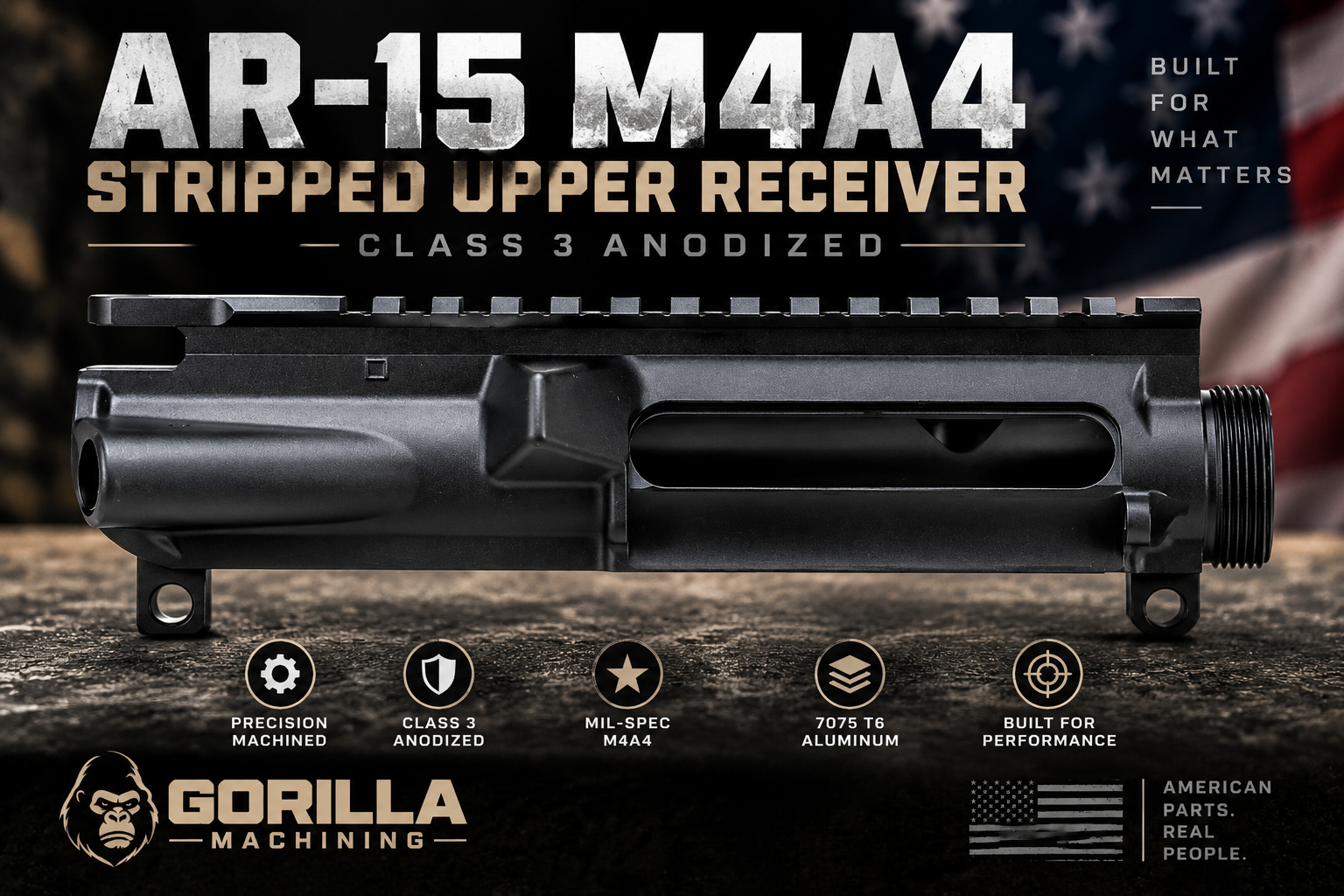
How AR-15 Parts Are Anodized: Type III Hardcoat Anodizing Explained
If you've shopped for an AR-15 upper receiver, lower receiver, handguard, charging handle, or other aluminum component, you've probably encountered a specification such as:
TYPE III HARDCOAT ANODIZED
It's one of the most common finishes associated with quality aluminum AR components.
But what exactly does that mean?
Is anodizing basically black paint?
Is Type III different from regular anodizing?
Why can two black anodized AR parts sometimes be slightly different shades?
And what does the anodizing process actually do to aluminum?
The answer starts with something important:
Anodizing isn't paint.
It's an electrochemical process that changes the surface of the aluminum itself.
Why Aluminum AR Parts Are Anodized
Aluminum offers an excellent combination of strength and relatively low weight, which is one reason alloys such as 7075-T6 and 6061-T6 are widely used throughout the AR platform.
But bare aluminum can benefit significantly from additional surface protection.
Anodizing creates a controlled aluminum-oxide layer at the surface.
That oxide layer can improve properties such as:
Wear resistance
Corrosion resistance
Surface hardness
Durability
and, depending on the process, appearance.
For firearm components exposed to handling, friction, moisture, cleaning products and environmental conditions, those characteristics can be valuable.
What Is Anodizing?
Anodizing is an electrochemical conversion process.
Instead of simply spraying a coating onto the aluminum, the component is placed into a controlled electrolytic environment.
Electrical current is then used to promote formation of an aluminum-oxide layer on the surface.
The aluminum component effectively becomes the anode in the electrochemical process—which is where the word anodizing comes from.
The resulting oxide layer is integrated with the underlying aluminum rather than simply sitting on top like conventional paint.
Is Anodizing a Coating?
This is where terminology can become confusing.
People often casually call anodizing a "coating."
Technically, it's better understood as a conversion of the aluminum surface into aluminum oxide.
Part of the anodized layer develops into the original surface and part develops outward from it.
That's important in precision manufacturing because anodizing can affect final dimensions.
For a decorative item, a small dimensional change may not matter much.
For a precision-machined firearm component, it can.
What Is Type III Hardcoat Anodizing?
There are several classifications of anodizing.
For AR components, one of the most important is:
TYPE III HARDCOAT ANODIZING
Type III is commonly called:
Hardcoat anodizing
or
Hard anodizing
Compared with thinner decorative anodizing processes, Type III is intended to create a thicker, harder oxide layer.
It's commonly used on components where wear resistance and durability are important.
That makes it particularly well suited to industrial, aerospace, military and firearm applications.
Type II vs. Type III Anodizing
One easy way to understand hardcoat anodizing is to compare it with Type II.
| Feature | Type II | Type III Hardcoat |
|---|---|---|
| Primary use | Decorative/general protection | Wear & durability |
| Oxide layer | Generally thinner | Generally thicker |
| Surface hardness | Increased | Significantly increased |
| Dye capability | Excellent | Possible, but more challenging |
| Common industrial use | Yes | Yes |
| Common on AR receivers | Less typical | Very common |
Type II isn't necessarily "bad."
It's simply designed around different requirements.
For AR receivers and other demanding aluminum components, Type III hardcoat has become an industry standard.
What Does MIL-A-8625 Type III Mean?
You'll sometimes see AR components advertised as:
MIL-A-8625 TYPE III
MIL-A-8625 is a long-standing U.S. military specification covering anodic coatings for aluminum and aluminum alloys.
Modern references may use MIL-PRF-8625, which superseded the older MIL-A designation.
Type III under that specification refers to hard anodic coatings.
This is why you'll often see phrases such as:
Mil-Spec Type III Hardcoat
in AR product descriptions.
However, there's an important distinction.
A manufacturer simply describing a product as "mil-spec" doesn't necessarily tell you every detail of the process, coating thickness, class, inspection or certification.
Specific documentation matters when formal specification compliance is required.
What Does Class 1 vs. Class 2 Mean?
Within Type III anodizing, you may encounter:
Class 1
and
Class 2
Generally:
Class 1
Anodic coating without added coloring.
Class 2
Anodic coating that has been dyed or otherwise colored.
For AR components, black Type III Class 2 is extremely common.
That's where the familiar black AR receiver appearance comes from.
How Does an AR Part Go From Raw Aluminum to Black?
Imagine a freshly machined raw 7075-T6 upper receiver.
It begins with the natural silver-gray appearance of machined aluminum.
At a high level, the anodizing workflow includes several carefully controlled stages.
Step 1: Cleaning the Aluminum
Before anodizing, the surface needs to be extremely clean.
Machining can leave behind:
Cutting fluids
Oil
Coolant
Fingerprints
Contamination
and other residues.
Surface preparation is critical because contaminants can interfere with consistent anodizing.
Step 2: Surface Preparation
Depending on the desired finish and manufacturing specification, additional preparation may be performed.
This can influence the final appearance.
That's one reason the surface finish coming out of the machine shop matters.
Anodizing doesn't magically hide poor machining.
In many cases, machining marks and surface characteristics can remain visible after anodizing.
A quality final finish begins before the part ever reaches the anodizing tank.
Step 3: The Anodizing Bath
The aluminum component is immersed in an acidic electrolyte.
For conventional sulfuric-acid anodizing, sulfuric acid is commonly involved.
Electrical current is passed through the system.
The aluminum part acts as the anode.
Under controlled conditions, aluminum at the surface reacts to form an aluminum-oxide structure.
Step 4: Building the Hardcoat Layer
Type III anodizing requires tightly controlled processing conditions.
Hardcoat anodizing is typically performed at lower bath temperatures and higher current densities than conventional decorative sulfuric anodizing.
The process builds a substantially thicker and harder oxide layer.
Temperature, current density, alloy, processing time and bath chemistry all influence the result.
This is where industrial process control becomes extremely important.
Step 5: Adding Color
Fresh anodized aluminum has a microscopic porous oxide structure.
Before those pores are sealed, coloring can be introduced.
For many AR components:
That color is black.
The dye enters the porous anodic structure.
This is why a black anodized receiver isn't simply a raw receiver covered in black paint.
The coloration is incorporated into the anodized surface structure.
Step 6: Sealing
After coloring, the anodized surface may undergo a sealing process.
Sealing closes or modifies the pores within the anodic layer.
This helps improve characteristics such as corrosion resistance and dye retention.
Different sealing processes can be used depending on the required specification and application.
Why Two Black AR Parts Don't Always Match
This is one of the most useful things to explain to customers.
You can place two high-quality black anodized components next to each other and notice:
One looks deep black.
Another looks slightly gray.
Another may have a subtle purple or bronze tone under certain lighting.
That doesn't automatically mean one was improperly anodized.
What Causes Anodizing Color Variation?
Several variables can influence the final appearance.
These include:
Aluminum alloy
Raw material composition
Surface finish
Machining finish
Anodizing bath conditions
Coating thickness
Dye concentration
Processing time
Sealing
Production batch
Even components anodized to the same general specification can exhibit slight color differences.
7075 vs. 6061 Can Anodize Differently
This is particularly relevant to AR manufacturing.
A receiver may be manufactured from 7075-T6, while a handguard may be manufactured from 6061-T6.
These alloys have different chemical compositions.
That means they don't necessarily respond identically during anodizing.
So if your:
7075 upper receiver
and
6061 handguard
aren't exactly the same shade of black, that alone doesn't mean either component is defective.
Different aluminum alloys can produce slightly different anodized appearances.
Why Black Can Look Purple
Customers sometimes describe anodized AR parts as having a purple tint.
This can become more noticeable under:
Bright sunlight
LED lighting
Camera flashes
or certain viewing angles.
Several factors involving alloy composition, dye chemistry, coating characteristics and processing conditions can contribute to perceived color variation.
Older firearms with anodized aluminum components are particularly famous for occasionally developing unusual gray, bronze or purple-looking tones.
Does Anodizing Change Part Dimensions?
Yes—which is extremely important for machinists.
Anodizing builds an oxide layer at the aluminum surface.
Because part of that layer grows outward, the process can affect dimensions.
That means manufacturers producing precision components need to account for the finishing process when establishing machining dimensions and tolerances.
This is known as finish allowance or dimensional compensation.
You don't simply machine every feature to its final target dimension and then ignore what the finishing process will do.
Why Tolerances Matter Before Anodizing
Imagine a precisely machined feature where only a few thousandths of an inch determine whether two components fit correctly.
Adding surface growth without considering it could change that fit.
That's why professional manufacturing involves understanding:
Raw material
Machining tolerance
Surface treatment
and
final inspection
as one connected process.
The drawing and manufacturing plan need to account for the final condition of the part.
Anodizing vs. Cerakote
These are often confused, but they're fundamentally different.
Anodizing
Electrochemically converts the aluminum surface into an oxide layer.
Cerakote
A ceramic-based coating system applied over a prepared surface.
That means Cerakote can be applied in a huge variety of colors and patterns.
Anodizing offers fewer aesthetic possibilities but provides a fundamentally different surface treatment.
Anodizing vs. Cerakote Comparison
| Feature | Type III Anodizing | Cerakote |
|---|---|---|
| Process | Electrochemical | Applied coating |
| Aluminum-specific | Primarily aluminum | Many materials |
| Surface conversion | Yes | No |
| Color options | More limited | Extensive |
| Common AR use | Receivers, handguards, aluminum parts | Receivers, handguards & many other components |
| Wear protection | Excellent | Excellent when properly applied |
| Adds coating layer | Oxide growth | Yes |
Some components can even be anodized first and subsequently receive another finish depending on the manufacturer's process and desired result.
What Does Raw Mean?
When Gorilla Machining lists an aluminum component as:
RAW
it generally means the component hasn't yet received its final protective anodized or other surface finish.
A raw aluminum component typically displays the natural appearance of the machined alloy.
This can also make machining characteristics much easier to see.
Tool paths, forging texture and surface transitions may all be more noticeable before finishing.
Why Raw Parts Are Interesting From a Manufacturing Perspective
A finished black component hides some of the visual story of how it was manufactured.
Raw components can reveal:
CNC tool paths
Machined surfaces
Forging texture
Deburring
Edge transitions
and other manufacturing details.
For people interested in machining, a raw AR component can be an excellent example of the manufacturing work that happens before finishing.
Is Anodizing Just for Appearance?
Absolutely not.
Black is the appearance customers notice first.
But Type III hardcoat anodizing is primarily valuable because of its functional surface properties.
A quality anodized finish can provide:
Surface hardness
Wear resistance
Corrosion protection
Durability
and a consistent finished surface.
The black color is only the most visible part.
Can Anodizing Scratch?
Yes.
Hardcoat anodizing is highly wear resistant, but it isn't indestructible.
Sharp objects, heavy abrasion, impact or repeated metal-to-metal contact can eventually produce visible wear.
A scratch doesn't necessarily indicate that the entire anodized finish is defective.
Areas of repeated mechanical contact commonly develop visible wear over time.
Does Anodizing Hide Blemishes?
Usually not.
This is another misconception.
Anodizing isn't a thick filler coating designed to hide machining imperfections.
Surface marks present before anodizing can remain visible afterward.
That's why manufacturers need good surface preparation and machining quality before finishing.
The finish can only be as good as the surface underneath it.
How Manufacturers Inspect Anodized Parts
Quality control doesn't stop once a component comes out black.
Depending on the manufacturer's requirements, inspection may consider:
Appearance
Coverage
Dimensions
Coating thickness
Surface condition
Color consistency
and compliance with applicable specifications.
For precision components, dimensional inspection after finishing can be especially important.
Frequently Asked Questions
What does Type III anodized mean?
Type III refers to hard anodic coatings designed to provide greater thickness, hardness and wear resistance than conventional decorative anodizing.
Is Type III anodizing Mil-Spec?
Type III anodizing is defined within specifications including MIL-PRF-8625. A generic "Type III" marketing claim shouldn't automatically be interpreted as documented compliance with every military specification requirement.
Is anodizing paint?
No. Anodizing electrochemically converts the aluminum surface into aluminum oxide.
Why don't my black AR parts perfectly match?
Different aluminum alloys, production batches, surface finishes and anodizing conditions can produce variations in shade.
Is 7075 anodizing different from 6061?
The same general anodizing processes can be applied to both, but differences in alloy composition can affect the final appearance and processing behavior.
Can anodizing wear off?
It can experience wear or damage under enough abrasion or mechanical contact. No firearm finish is completely immune to wear.
Is Cerakote the same as anodizing?
No. Cerakote is an applied ceramic-based coating, while anodizing is an electrochemical surface-conversion process primarily used with metals such as aluminum.
Conclusion
When you see:
TYPE III HARDCOAT ANODIZED
on an AR-15 component, you're looking at much more than a black color.
The process begins with precisely machined aluminum.
The component is cleaned and prepared before undergoing an electrochemical process that creates a durable aluminum-oxide surface.
Depending on the specification, the surface can then be colored and sealed.
But one of the most important lessons is what happens before anodizing.
A quality finished AR component starts with:
Quality material ? Precision machining ? Proper surface preparation ? Controlled anodizing ? Final inspection
Anodizing doesn't replace good machining.
It protects and finishes the machining work that's already there.
That's what makes Type III hardcoat anodizing such an important part of modern AR component manufacturing.

