
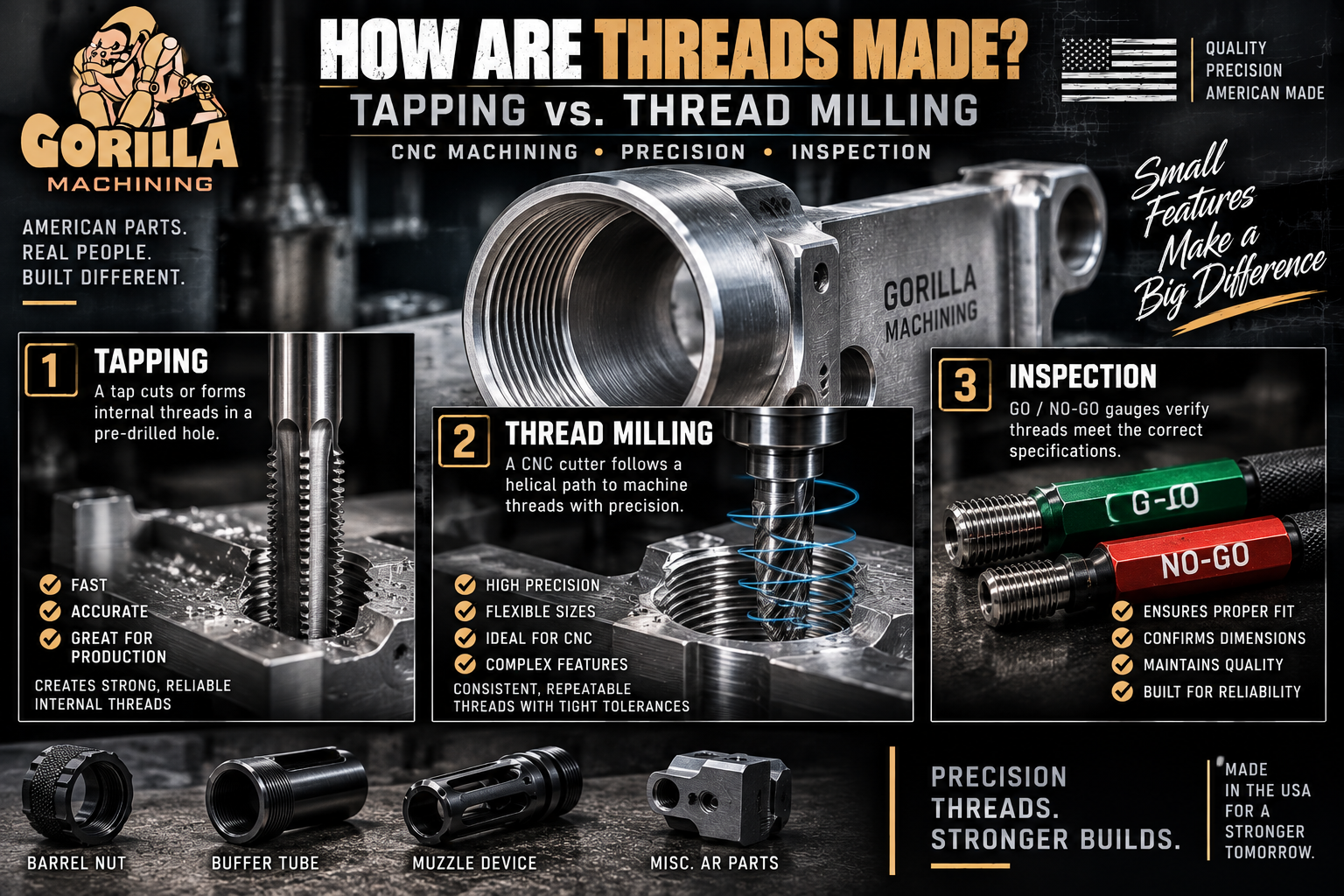
How Threads Are Made on AR-15 Parts: Tapping, Thread Milling & CNC Machining Explained
Threads are everywhere in precision manufacturing.
You see them on fasteners, mounts, housings, machinery, automotive components, and countless other products.
They're also found throughout the AR platform.
But a thread isn't simply a spiral cut into metal.
For two threaded components to work together correctly, several characteristics must match.
That includes:
Diameter
Pitch
Thread form
Depth
Alignment
and dimensional tolerance.
So how does a manufacturer take a solid piece of aluminum or steel and create accurate, repeatable threads?
There are several ways to do it.
What Is a Machined Thread?
A thread is a helical feature formed around the inside or outside of a cylindrical surface.
There are two basic categories.
Internal Threads
These are located inside a hole.
Think of a threaded hole that accepts a screw or fastener.
External Threads
These are located around the outside of a cylindrical feature.
A bolt is a familiar example.
For the two components to engage correctly, their thread geometry needs to be compatible.
What Does Thread Pitch Mean?
Thread pitch describes the spacing between threads.
For inch-based threads, you'll often see specifications expressed using:
Threads Per Inch — TPI
For example, a specification ending in -20 indicates 20 threads per inch.
Metric threads typically identify the distance between threads directly in millimeters.
Pitch is important because two components can appear similar in diameter while having completely different thread spacing.
If the pitch doesn't match, the components aren't designed to thread together.
Thread Diameter Matters Too
The nominal diameter is another key part of a thread specification.
Two threads can have the same pitch but different diameters.
Likewise, two threads can have similar diameters but different pitches.
That's why manufacturers don't identify threads based simply on:
“It looks about this big.”
Threads are engineered features with defined geometry.
What Is Thread Form?
Look closely at a thread from the side and you'll see that each thread has a defined profile.
The shape and angle of that profile are known as the:
Thread form.
Different thread standards exist for different applications.
The manufacturer needs to know which standard applies before machining begins.
This is another example of why standardization matters.
How Are Internal Threads Made?
One traditional method for producing internal threads is:
TAPPING
A tap is a specialized cutting tool designed to create threads inside a prepared hole.
Before tapping can occur, the manufacturer first creates a correctly sized hole.
The tap then enters that hole and forms or cuts the required thread geometry, depending on the type of tap and process being used.
What Is a Cutting Tap?
A cutting tap removes material as it creates the thread.
Its cutting edges form the internal thread profile while chips are generated and removed from the hole.
Different tap designs are available depending on factors such as:
Material
Hole depth
Blind vs. through hole
Chip control
and production requirements.
Tool selection matters.
What Is a Form Tap?
Not every tap creates threads by cutting material away.
A form tap, sometimes called a roll tap, produces threads by displacing material.
Instead of generating chips in the same way as a cutting tap, it forms the material into the required thread geometry.
This technique works well with certain ductile materials and applications.
Cut tapping and form tapping therefore achieve a similar goal through very different processes.
What Is Thread Milling?
Modern CNC manufacturing offers another method:
THREAD MILLING
Instead of using a tap shaped like the complete thread, a CNC machine uses a specialized milling cutter.
The cutter moves through a controlled helical toolpath to generate the thread.
In simplified terms, the tool simultaneously moves:
Around the hole
and
Along its axis.
That coordinated CNC movement produces the helical thread.
Tapping vs. Thread Milling
Both methods can produce quality threads when properly applied.
But they work differently.
| Tapping | Thread Milling |
|---|---|
| Uses a tap | Uses a milling cutter |
| Tool follows existing hole | Tool follows programmed helical path |
| Common and efficient | Highly CNC-controlled |
| Different taps needed for different pitches/sizes | Tooling can sometimes offer greater flexibility |
| Tool occupies much of the hole | Cutter is typically smaller than the hole |
| Chip management can be important | Can provide controlled chip evacuation |
Neither process is automatically “better” for every application.
Manufacturers choose the process based on the material, geometry, volume, equipment, and engineering requirements.
Why Thread Milling Is Interesting
Thread milling demonstrates what modern CNC equipment can accomplish through coordinated motion.
The tool itself doesn't necessarily look like the complete finished thread.
Instead, the machine creates the geometry through movement.
That makes the CNC program extremely important.
Tool diameter, toolpath, position, and machining parameters all influence the final result.
How Are External Threads Made?
External threads can also be produced in several ways.
Depending on the component and manufacturing environment, manufacturers may use processes including:
Single-point threading
Thread milling
Dies
Thread rolling
and other specialized methods.
Again, the correct process depends on the component.
What Is Single-Point Threading?
Single-point threading is commonly associated with turning operations.
A cutting tool follows a controlled helical path along a rotating workpiece.
Each pass removes material until the required thread geometry is achieved.
Modern CNC lathes can control this process very precisely.
This is another good example of CNC synchronization.
The tool movement must remain coordinated with the rotation of the workpiece.
What Is Thread Rolling?
Thread rolling works very differently from cutting.
Instead of removing material, hardened dies form the thread by displacing the workpiece material.
This is a forming process.
Because material isn't removed in the same manner as cutting, rolled threads can have different characteristics from cut threads.
Thread rolling is widely used for high-volume fastener production and other appropriate applications.
Why Starting Diameter Matters
Before an external thread is machined, the starting cylindrical feature needs to be properly sized.
Likewise, an internal thread requires an appropriately sized starting hole.
If the starting geometry is incorrect, the final thread geometry can also be incorrect.
This illustrates an important manufacturing principle:
The quality of the final operation often depends on the accuracy of the operation before it.
What Is a Thread Chamfer?
Look at the beginning of many professionally machined threads and you'll notice a small angled edge.
That's often a:
Chamfer.
A chamfer can help create a controlled transition at the beginning of the threaded feature.
It can also remove sharp edges left by machining.
This connects directly with our previous article about deburring.
Why Threads Need Deburring
Thread manufacturing can leave small burrs around entrances, exits, or intersecting features.
Those unwanted edges need to be addressed appropriately.
However, aggressive deburring can also damage thread geometry.
That's why secondary finishing operations need to be controlled.
Remove the burr—not the feature.
Why Thread Alignment Matters
A thread can have the correct diameter and pitch but still cause problems if its axis isn't properly located or aligned relative to the component.
This is where machining setup and geometric control become important.
The threaded feature doesn't exist independently.
It's part of a larger component.
Its position and orientation may matter just as much as the thread itself.
What Is Cross-Threading?
Cross-threading occurs when mating threads begin engaging incorrectly rather than following their intended helical paths.
This can damage one or both threaded components.
It isn't the same thing as a thread being manufactured incorrectly.
A properly manufactured thread can still be damaged through improper engagement, contamination, or other causes.
This distinction is important when diagnosing thread damage.
What Do Damaged Threads Look Like?
Potential signs of thread damage can include:
Flattened thread crests
Missing material
Deformation
Galling
Heavy burrs
or visibly interrupted thread geometry.
A small cosmetic mark on the exterior of a component isn't necessarily thread damage.
The actual thread surfaces need to be evaluated.
What Is Galling?
Galling is a form of adhesive wear that can occur when contacting metal surfaces slide against one another under certain conditions.
Material can transfer between the surfaces, resulting in roughness or damage.
Material selection, surface treatment, lubrication, load, and other factors can influence galling behavior.
It is particularly relevant in threaded mechanical assemblies.
How Manufacturers Inspect Threads
You can't reliably verify every aspect of a precision thread simply by looking at it.
Manufacturers therefore use inspection equipment.
One common method involves:
GO / NO-GO THREAD GAUGES
These provide a practical way to evaluate whether a threaded feature falls within specified limits.
What Is a GO Gauge?
Conceptually, the GO gauge checks one side of the allowable thread condition.
It should engage according to the inspection requirements for that thread.
What Is a NO-GO Gauge?
The NO-GO gauge evaluates the opposite limit.
It should not engage beyond the amount permitted by the applicable inspection criteria.
Together, these gauges help verify that a thread falls within its acceptable dimensional range.
Why Not Just Use a Bolt?
This is an important quality-control lesson.
Screwing a random bolt or component into a threaded hole may tell you whether those two particular pieces happen to engage.
It doesn't necessarily verify that the thread meets its specified dimensional limits.
A calibrated thread gauge provides a known inspection reference.
“It screws together” and “it meets specification” aren't always the same statement.
Threads and Surface Finishing
Thread dimensions can also interact with surface treatments.
For example, aluminum components may receive anodizing after machining.
Because anodizing changes the surface, manufacturers need to consider the final finished condition when controlling precision features.
This connects directly with our earlier Type III hardcoat article.
Machining and finishing shouldn't be treated as completely separate worlds.
Why Tool Wear Matters
Thread-cutting tools don't last forever.
As tooling wears, cutting performance and geometry can change.
Production manufacturers therefore monitor:
Tool life
Surface condition
Dimensions
and inspection results.
A CNC program can be perfect, but worn tooling can still create problems.
This is why machining requires ongoing process control.
Why Coolant Matters
Machining threads can generate heat and chips.
Depending on the material and process, cutting fluid or coolant can help with:
Heat control
Lubrication
Chip evacuation
and tool life.
Proper coolant strategy is another behind-the-scenes detail customers rarely see but manufacturers have to consider.
Why Threads Are a Good Test of Machining Quality
Threads combine several manufacturing challenges:
Precise dimensions
Repeated geometry
Surface finish
Tool condition
Alignment
and inspection.
They may occupy only a small portion of the component, but a poorly manufactured thread can make an otherwise excellent part unusable.
That's why small features can deserve significant attention.
Threads Are Everywhere
Once you start looking for threaded features on machined products, you'll see them everywhere.
Not just on firearm components.
They're fundamental to:
Automotive manufacturing
Aerospace
Industrial machinery
Electronics
Construction equipment
and everyday consumer products.
Thread manufacturing is one of the foundations of modern precision manufacturing.
Frequently Asked Questions
What is thread milling?
Thread milling uses a CNC-controlled milling cutter following a helical path to create a thread.
Is thread milling the same as tapping?
No. A tap and a thread mill create threads using different tools and machining strategies.
What's the difference between internal and external threads?
Internal threads are created inside a hole. External threads are created around the outside of a cylindrical feature.
What does TPI mean?
TPI stands for threads per inch, a common way of describing thread pitch in inch-based thread systems.
What is a form tap?
A form tap creates threads by displacing material rather than cutting chips in the same way as a conventional cutting tap.
What is a GO/NO-GO thread gauge?
It's an inspection system used to evaluate whether a threaded feature falls within specified dimensional limits.
Can anodizing affect threads?
Surface treatments can influence finished dimensions, so manufacturers may need to account for the final surface condition when producing precision threaded features.
Conclusion
Threads may look simple, but manufacturing them correctly requires control over numerous variables.
The manufacturer has to consider:
Diameter
Pitch
Thread form
Tooling
Alignment
Material
Surface treatment
and
Inspection.
Some threads are tapped.
Some are thread milled.
Others are cut on a lathe or formed through processes such as thread rolling.
Different methods can reach the same basic goal:
Producing repeatable geometry that allows compatible components to interface correctly.
It's another great example of why precision manufacturing is about much more than making metal look good.
Small features still require big attention to detail.

