
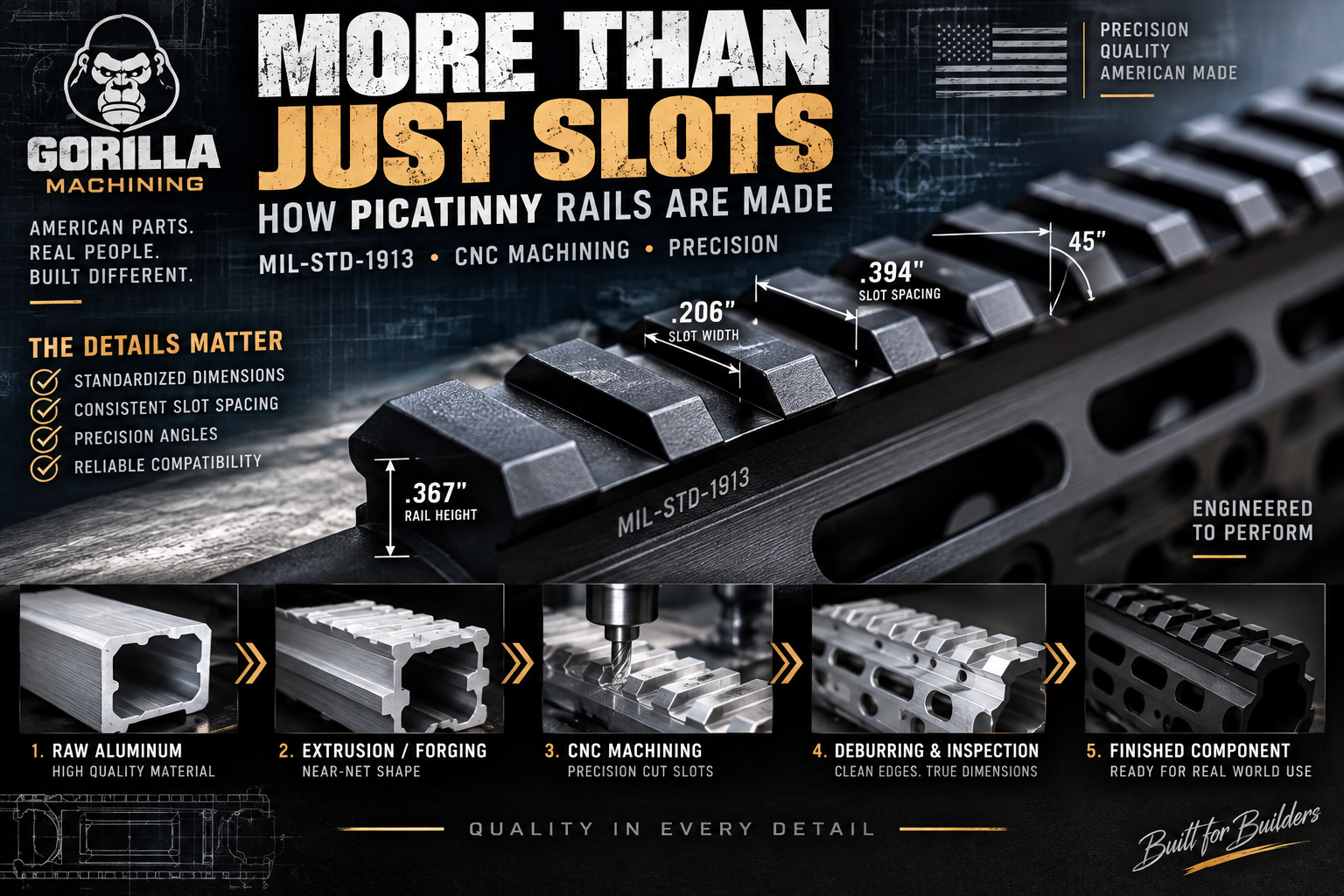
How Picatinny Rails Are Made: Understanding MIL-STD-1913 & Precision Machining
The Picatinny rail is one of the most recognizable features found on modern firearm components.
You'll see it on:
Upper receivers
Handguards
Optic mounts
and numerous other accessories.
At first glance, the design seems simple.
It's basically a row of raised sections separated by slots.
But from a machining perspective, there's much more going on.
The rail's usefulness comes from standardized geometry.
The width, slot spacing, angles, and other dimensions must work together so compatible accessories can interface with the rail as intended.
That means a Picatinny rail isn't simply a decorative pattern machined into aluminum.
It's a precision interface.
What Is a Picatinny Rail?
A Picatinny rail is a standardized mounting interface used for attaching compatible equipment.
It is commonly referred to as:
Picatinny
1913 Rail
or
MIL-STD-1913 Rail
The system is recognizable by its repeating transverse slots and distinctive cross-sectional profile.
Standardization allows separately manufactured compatible products to share a common mounting interface.
That's the important part:
The rail and the accessory don't necessarily come from the same manufacturer.
Their ability to work together depends on both being made to compatible dimensional standards.
Why Is It Called a Picatinny Rail?
The name is associated with Picatinny Arsenal in New Jersey.
The standardized rail specification became known as MIL-STD-1913.
That specification established dimensional requirements for the accessory mounting rail.
Over time, “Picatinny rail” became the common industry term.
Why Does Standardization Matter?
Imagine every manufacturer making its own version of a mounting rail.
One company's optic mount might fit.
Another might be too tight.
Another could be too loose.
Another might not fit at all.
A dimensional standard provides manufacturers with a common reference.
That allows companies producing completely different products to design around the same interface.
This concept is known as:
Interoperability.
It's one of the most important benefits of standardized manufacturing.
A Picatinny Rail Is More Than the Slots
When people look at a rail, the slots usually get all the attention.
But the complete geometry matters.
A properly manufactured rail involves controlled features such as:
Overall profile
Angled surfaces
Slot geometry
Slot spacing
Rail width
Feature location
and dimensional relationships between those surfaces.
Changing one dimension can influence how another component interfaces with the rail.
How Does a Picatinny Rail Start?
For an aluminum upper receiver or handguard, the rail begins as part of the component's raw material.
Depending on the product, that starting material could come from:
A forging
An extrusion
or
Billet/bar stock
The manufacturing route varies by component.
For example, an upper receiver may begin as a forging.
A handguard may begin from an aluminum extrusion.
The CNC machine then creates the final rail geometry.
What Is an Extrusion?
Extrusion is particularly important in handguard manufacturing.
In simplified terms, aluminum is pushed through a specially shaped die to create a long piece of material with a consistent cross-sectional profile.
Think of squeezing material through a precisely shaped opening.
The resulting aluminum can already resemble the basic shape needed for the final handguard.
Manufacturers then cut it to length and perform CNC operations to create the finished features.
This can significantly reduce the amount of material that must be machined away.
Extrusion Doesn't Mean Finished
Just like a forging isn't a finished receiver, an extrusion isn't necessarily a finished handguard.
The extrusion provides the starting geometry.
Additional machining can create features such as:
Picatinny rail slots
Accessory interfaces
Ventilation openings
Mounting features
QD locations
and other design elements.
Afterward, the component may still require deburring, inspection, surface preparation, and finishing.
How CNC Machining Creates the Rail
Once the component is properly secured inside a CNC machining center, cutting tools create the final rail features.
At a high level, the machine follows programmed toolpaths that establish the required geometry.
The challenge is repeatability.
Each slot needs to maintain the correct relationship to the surrounding features.
A tiny error repeated over a long rail can become increasingly noticeable.
Why Slot Spacing Matters
Look at a long Picatinny rail and you'll notice a repeating pattern.
That repetition is intentional.
Accessories may engage one or several rail sections.
If the spacing isn't controlled consistently, compatibility can suffer.
This is where precision CNC machining becomes important.
The machine must repeatedly position the cutting tool while maintaining the required geometry across the component.
Why Rail Angles Matter
The side profile of a Picatinny rail includes angled engagement surfaces.
Compatible mounts use those surfaces as part of their clamping interface.
If the profile is incorrectly machined, a mount could potentially fit too tightly, too loosely, or inconsistently.
So while the top of the rail may look simple, the cross-sectional geometry is critical.
Picatinny vs. Weaver
These two systems are often confused because they look similar.
Weaver-style rails
Predate the standardized Picatinny system and can have differences in slot dimensions and spacing.
Picatinny rails
Use standardized geometry associated with the 1913 specification.
Some accessories can work across both systems, but that doesn't mean the two standards are identical.
This is why reading the manufacturer's compatibility information is important.
What Does “Continuous Top Rail” Mean?
You'll often see handguards advertised with a:
Continuous Picatinny Top Rail
This means the rail runs along the top of the component rather than appearing only in short isolated sections.
When paired with an upper receiver, manufacturers generally want the handguard's rail to visually and dimensionally align appropriately with the receiver rail.
This creates another manufacturing challenge.
Why Upper and Handguard Alignment Matters
An upper receiver and handguard are separate components.
Yet when assembled, customers expect the top surfaces to appear aligned.
Several manufacturing variables influence that relationship:
Receiver dimensions
Handguard dimensions
Mounting system
Extrusion geometry
CNC machining
and accumulated tolerances.
This brings us back to something we discussed in our tolerance blog:
Multiple individually acceptable components can still interact through tolerance stacking.
Precision manufacturing helps control that variation.
Why Longer Rails Can Be Challenging
A small dimensional deviation may not appear significant over a short distance.
Across a long component, however, maintaining:
Straightness
Parallelism
Slot consistency
and alignment becomes increasingly important.
The component must also remain properly supported during machining.
That's where good workholding and process control matter.
Workholding a Handguard
Handguards can be relatively long and thin compared with more compact components.
That creates interesting machining challenges.
The manufacturer needs to hold the part securely without allowing unwanted movement or distortion.
Poor workholding can contribute to:
Vibration
Chatter
Dimensional variation
or inconsistent surface finish.
The fixture therefore becomes part of the manufacturing process.
Tool Deflection Matters Too
Cutting tools aren't infinitely rigid.
Under machining forces, a cutting tool can experience tiny amounts of deflection.
Machinists compensate for this through proper:
Tool selection
Cutting parameters
Toolpath strategy
Workholding
and machine setup.
These variables can influence the consistency of the finished rail.
What Happens After Machining?
Once machining is complete, the component isn't necessarily ready for sale.
Additional manufacturing stages can include:
Deburring
Inspection
Surface preparation
Anodizing
and
Final quality control
This connects directly with several topics we've already covered in this manufacturing series.
Each process contributes to the final product.
Type III Hardcoat Anodizing
Many aluminum AR handguards and upper receivers receive Type III hardcoat anodizing after machining.
As we covered previously, anodizing isn't simply black paint.
It's an electrochemical process that creates a controlled oxide layer at the aluminum surface.
Manufacturers need to consider finishing requirements as part of the complete production process.
Why Measuring the Rail Matters
Visual inspection can identify obvious problems.
But dimensional inspection provides objective information.
Manufacturers can use appropriate inspection equipment to evaluate critical rail characteristics.
Depending on the production environment, this could involve specialized gauges, conventional measuring equipment, optical measurement, or coordinate measuring systems.
The exact inspection method depends on the manufacturer's requirements.
Why “Looks Like Picatinny” Isn't Enough
This is one of the most important lessons.
A rail can visually resemble a Picatinny rail while still having incorrect dimensions.
Appearance alone doesn't establish compliance with a dimensional standard.
The same is true throughout precision manufacturing.
Geometry has to be measured—not guessed.
What Does MIL-SPEC Really Mean Here?
The phrase mil-spec is used very loosely in firearm marketing.
MIL-STD-1913, however, refers to an actual military standard defining the accessory mounting rail interface.
A product being described casually as “mil-spec” doesn't automatically prove that every applicable requirement has been independently verified.
Customers should look for specific specifications rather than relying solely on generic marketing terminology.
Why Machining Quality Matters
A properly manufactured rail requires more than simply cutting repeating slots.
The manufacturer needs control over:
Material
Starting geometry
CNC programming
Cutting tools
Workholding
Tool wear
Tolerances
Deburring
Finishing
and
Inspection.
That repeating rail pattern is the visible result of a much larger manufacturing system.
Frequently Asked Questions
What does 1913 rail mean?
It refers to the standardized accessory mounting rail commonly associated with MIL-STD-1913 and known as the Picatinny rail.
Is Picatinny the same as Weaver?
No. They have similarities, but their dimensional standards aren't identical.
Are Picatinny rails CNC machined?
Many aluminum firearm components use CNC machining to create their final rail features, although exact manufacturing methods depend on the product.
Why does Picatinny slot spacing matter?
Consistent slot geometry helps compatible accessories interface with the standardized rail system as intended.
What does continuous top rail mean?
It generally describes a rail that runs continuously along the top of a component rather than appearing only in short sections.
Are AR handguards machined from solid blocks?
Some may be, but many aluminum handguards begin from extruded material that is subsequently CNC machined.
Is an extrusion already a finished handguard?
No. The extrusion provides a starting profile. Significant machining and finishing can still be required.
Conclusion
The Picatinny rail is a perfect example of something that looks simple until you examine how it's manufactured.
Those repeating slots aren't there merely for appearance.
They're part of a standardized mounting interface that depends on controlled geometry.
And creating that geometry requires much more than pressing Start on a CNC machine.
It takes:
Quality material
Proper workholding
Accurate CNC programming
Good tooling
Controlled tolerances
Deburring
Finishing
and
Inspection.
The next time you look across the top rail of an upper receiver or handguard, you're looking at a great example of an important manufacturing principle:
Standardization only works when the dimensions are right.

