
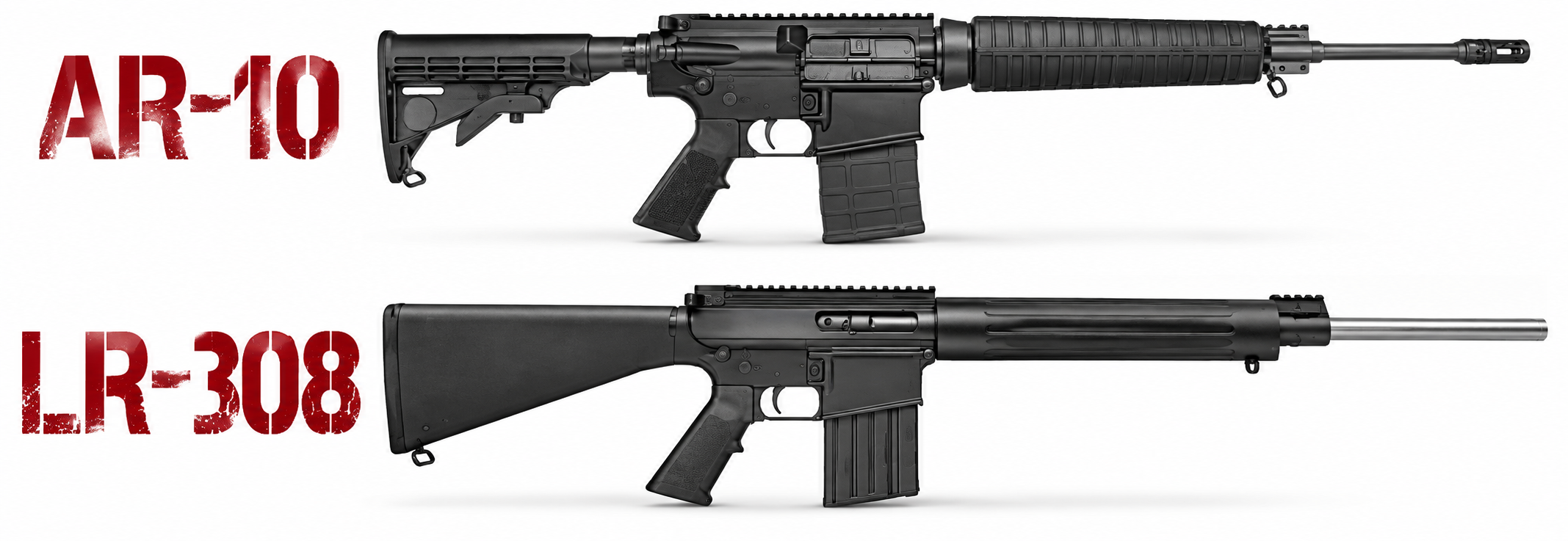
AR-10 vs. LR-308: Why the Names Cause So Much Confusion
If you've ever shopped for parts for a .308 AR-style rifle, you've probably seen several different names:
AR-10. LR-308. AR-308. DPMS Pattern. SR-25 Pattern.
At first glance, they can look like different names for essentially the same firearm.
They're not.
While these large-frame rifles share the familiar AR-style layout, there are important dimensional and component differences between platforms. A component described as fitting an “AR-10” should therefore not automatically be assumed to fit every .308 AR-style rifle. Brownells
Understanding where these names came from makes shopping for compatible components much easier.
Where Did the AR-10 Come From?
The original AR-10 traces back to ArmaLite. The company says it was founded in 1954 and developed the original AR-10 and AR-15 platforms. Armalite
Importantly, AR-10® is associated specifically with ArmaLite's platform, rather than being a universal technical standard covering every large-frame AR-style rifle.
Over time, other manufacturers developed their own .308-size AR platforms.
That's where things became more complicated.
What Is the LR-308?
The LR-308 name became associated with the large-frame platform developed by DPMS.
Today, you'll frequently see aftermarket components described as:
DPMS Pattern
or
LR-308 Pattern
Many modern large-frame components are based around this general architecture.
However, even seeing “DPMS compatible” doesn't mean you should assume every component from every manufacturer will interchange perfectly.
The large-frame AR market has considerably more variation than the AR-15 market.
Why Do People Call Everything an AR-10?
Mostly because AR-10 has become common shorthand in everyday conversation for a large-frame AR-style rifle.
Someone might say:
“I'm building an AR-10.”
But what they actually have could be a DPMS/LR-308-pattern receiver set rather than an ArmaLite AR-10.
That distinction becomes important the moment you start buying parts.
Brownells specifically cautions that calling every .308 AR an AR-10 can create compatibility problems because actual ArmaLite AR-10 parts and DPMS/LR-308-pattern components are not universally interchangeable. Brownells
AR-10 vs. LR-308: What's Different?
From across the room, the two platforms may look extremely similar.
But several areas can differ.
| Area | ArmaLite AR-10 | DPMS/LR-308 Pattern |
|---|---|---|
| Platform origin | ArmaLite | DPMS |
| Common generic terminology | AR-10 | LR-308 / AR-308 / DPMS Pattern |
| Upper/lower compatibility | Platform dependent | Platform dependent |
| Barrel/extension compatibility | Must verify | Must verify |
| Handguard/barrel nut | Pattern matters | Pattern/profile matters |
| BCG compatibility | Must verify | Must verify |
| Magazine compatibility | Depends on specific model/pattern | Often SR-25/DPMS style |
| Parts universally interchangeable? | No | No |
Brownells identifies upper receivers, barrel extensions, handguard mounting, bolts/headspacing, gas tubes and buffer components among areas where AR-10 and LR-308/AR-308 configurations can differ. Brownells
Even ArmaLite Has More Than One AR-10 Configuration
Here's another reason this subject gets confusing.
ArmaLite itself has produced AR-10A and AR-10B families.
According to ArmaLite's documentation, the AR-10A and AR-10B operate similarly, but their magazine systems differ. That difference also results in some unique components, including differences in receivers and certain controls. Armalite
So asking:
“Will this fit an AR-10?”
may not provide enough information to answer a compatibility question.
The Upper Receiver Is One of the First Things to Check
When you're buying a large-frame upper or lower receiver, identifying the receiver pattern is critical.
An upper designed around a DPMS/LR-308 configuration should not automatically be expected to mate correctly with an ArmaLite-pattern lower.
This differs from the AR-15 world, where component standardization is generally much broader.
For large-frame builds, it's smart to keep your upper and lower within a confirmed compatible receiver pattern, preferably using compatibility information supplied by the manufacturers.
DPMS High vs. Low Profile Adds Another Layer
And then there's another term shoppers encounter:
DPMS High Profile vs. DPMS Low Profile.
This generally relates to upper-receiver rail/handguard geometry.
Two products can both be described as DPMS-pattern components while still having differences that matter when selecting a handguard.
This is one reason you shouldn't shop based solely on the word “.308” or “AR-10.”
The actual receiver specifications matter.
What Parts May Be Shared?
Some components across large-frame AR platforms may use dimensions or interfaces shared with AR-15-style parts, while others are platform-specific.
Brownells notes examples of components that may interchange in certain configurations, including some fire-control components, pistol grips, muzzle devices and receiver extensions. But compatibility still needs to be checked for the specific firearm and component. Brownells
A product listing should always take priority over assumptions based on appearance.
Why This Matters for 8.6 Blackout Builds Too
This subject isn't limited to .308 Winchester.
The same large-frame compatibility questions become relevant when working with other cartridges based around these platforms, including 8.6 Blackout.
For example, the 8.6 Blackout barrel we've recently discussed for Gorilla Machining uses an LR-308/DPMS-compatible barrel extension.
That's useful information because simply labeling something an “8.6 Blackout AR-10 barrel” wouldn't tell the customer enough about its compatibility.
The pattern matters just as much as the caliber.
What Should You Check Before Ordering Large-Frame AR Parts?
Before purchasing components, identify:
- The manufacturer and model of your receiver
- Whether it uses an ArmaLite, DPMS/LR-308 or another pattern
- The upper-receiver profile where relevant
- The barrel extension and BCG compatibility
- The handguard and barrel-nut pattern
- The buffer-system requirements
- The caliber and chambering
- The manufacturer's stated compatibility
When you're unsure, don't rely solely on the phrase AR-10 in a product title.
Check the actual specifications.
AR-10 vs. LR-308 FAQ
Are AR-10 and LR-308 the same thing?
No. They are related large-frame AR-style platforms, but AR-10 refers specifically to the ArmaLite platform, while LR-308 refers to the DPMS-developed pattern. Their parts are not universally interchangeable. Brownells
Will an LR-308 upper fit an AR-10 lower?
Do not assume it will. Receiver dimensions and patterns can differ. Compatibility should be confirmed between the specific upper and lower manufacturers.
Is DPMS Pattern the same as LR-308?
LR-308 is the DPMS platform, which is why DPMS pattern and LR-308 pattern are commonly used together when describing compatible aftermarket components.
Why are so many products called AR-10 parts?
“AR-10” is frequently used informally as a general term for large-frame AR-style rifles, even when the product is actually intended for a DPMS/LR-308-type platform. That's why reading the compatibility specifications is important. Brownells
Are all DPMS-pattern parts interchangeable?
Don't assume so. Different generations, receiver profiles and manufacturer-specific dimensions can still affect compatibility. For example, Brownells listings explicitly distinguish some .308 AR components from the newer DPMS G2 platform. Brownells
The Bottom Line
The biggest thing to remember is simple:
AR-10 and LR-308 are not just two names for one completely standardized platform.
The large-frame AR market contains multiple patterns and manufacturer-specific variations. That's why knowing your receiver pattern, component specifications and manufacturer compatibility is essential when shopping for replacement parts or planning a build.
At Gorilla Machining, we recommend checking the complete specifications on each large-frame component rather than relying on “AR-10” as a universal compatibility label.

