
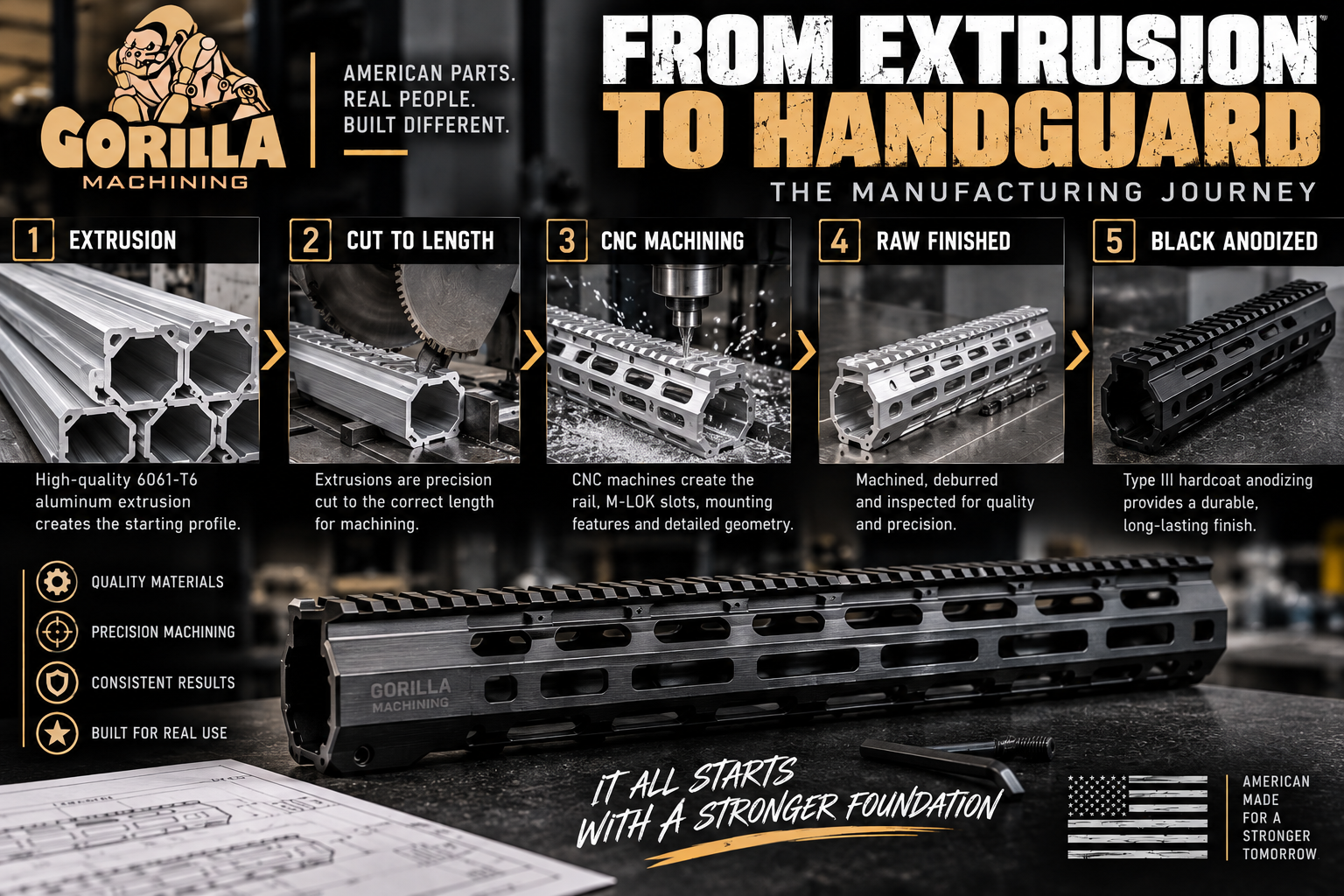
How AR-15 Handguards Are Made: From Aluminum Extrusion to Finished Part
Pick up a modern aluminum AR-15 handguard and it may look like one complicated piece of metal.
There are ventilation openings, accessory slots, a Picatinny top rail, mounting features, threaded areas, and carefully shaped surfaces.
It would be easy to assume the manufacturer starts with a giant solid block of aluminum and machines away everything that isn't the handguard.
But many aluminum handguards begin very differently.
They start as a long piece of specially shaped aluminum called an:
EXTRUSION
From there, CNC machining transforms that relatively simple aluminum profile into the finished handguard you see on the shelf.
So let's follow the manufacturing process from beginning to end.
What Is Aluminum Extrusion?
Aluminum extrusion is a manufacturing process used to create long pieces of material with a consistent cross-sectional shape.
A simple way to visualize extrusion is to imagine pushing material through a shaped opening.
The opening is called a:
Die.
As aluminum passes through the die, it takes on the die's cross-sectional profile.
Instead of starting with a rectangular block, manufacturers can therefore start with material that's already much closer to the basic shape they need.
Why Use Extrusions for Handguards?
Look at a typical free-float handguard from the front.
Its basic cross-sectional shape continues for much of its length.
That makes extrusion particularly useful.
The starting material can already incorporate portions of the general:
Outer profile
Inner cavity
Top section
and structural geometry.
CNC machinery then adds the more complex features.
This can reduce:
Material waste
Machining time
and the amount of metal that needs to be removed.
What Does a Raw Handguard Extrusion Look Like?
Before CNC machining, an extrusion can look surprisingly plain.
Imagine a long aluminum tube with the rough external shape of a handguard.
It may already have:
A hollow center
Basic exterior geometry
Additional material where the top rail will be located
and other features incorporated into its cross section.
But it generally won't yet contain all the recognizable details of the finished product.
Those come later.
Why 6061-T6 Aluminum Is Common
Many aluminum AR handguards are manufactured from 6061-T6 aluminum.
We've previously discussed 6061 and 7075, but handguards demonstrate why the “strongest material” isn't automatically required for every component.
6061-T6 offers a useful combination of:
Strength
Low weight
Machinability
Corrosion resistance
and suitability for extrusion.
That makes it a practical material for many handguard designs.
The Extrusion Arrives at the Machine Shop
Extrusions are produced in long lengths.
The manufacturer needs individual pieces suitable for machining.
The material can therefore be cut into sections corresponding to the handguard being manufactured.
Those pieces are essentially:
Handguard blanks.
They have the starting shape—but not the finished geometry.
Now the CNC work begins.
Step 1: Workholding
Before a CNC machine can accurately cut the extrusion, the material needs to be held securely.
This is called:
Workholding.
Handguards present an interesting challenge because they're relatively long and thin.
A fixture needs to hold the extrusion rigidly enough for machining while avoiding unwanted distortion.
If the workpiece moves or vibrates during cutting, surface finish and dimensional accuracy can suffer.
Step 2: Establishing Reference Surfaces
Precision machining depends on knowing exactly where the component is located.
The CNC setup establishes reference points so features can be machined in their correct positions.
These reference relationships matter because the handguard contains many features that need to align with one another.
The rail can't simply be “close.”
Neither can the mounting interface.
The geometry works as a complete system.
Step 3: Machining the Picatinny Rail
One of the most recognizable features is the top Picatinny rail.
As we discussed in our previous blog, the rail isn't merely a decorative row of slots.
Its geometry follows a standardized interface.
CNC machining creates the required rail features while maintaining controlled spacing and dimensions along the length of the handguard.
This can require careful attention to:
Tool positioning
Tool wear
Workholding
and dimensional consistency.
Step 4: Machining Accessory Slots
Modern free-float handguards commonly incorporate accessory mounting interfaces such as M-LOK.
These slots aren't simply random rectangular holes cut into the aluminum.
They follow defined geometry so compatible accessories can interface with the mounting system.
The CNC machine repeatedly creates those features along the handguard according to the product design.
Consistency matters.
Why Slot Alignment Matters
Look closely at a quality handguard.
Rows of slots should appear consistent from one end to the other.
Creating that appearance isn't simply cosmetic.
The machine must repeatedly position itself accurately across a relatively long component.
Even small positioning differences can become visible when a repeating pattern extends across the entire handguard.
This makes handguards an excellent example of CNC repeatability.
Step 5: Removing Material for Weight
Many modern handguards contain additional openings between structural sections.
These openings can help reduce weight while also contributing to the product's appearance and ventilation.
But manufacturers can't simply remove aluminum everywhere.
Material removal needs to be considered as part of the overall design.
A handguard needs to balance:
Weight + Rigidity + Manufacturing + Function.
Making something lighter is easy if you simply remove material.
Making it lighter while maintaining the intended structural characteristics is the engineering challenge.
Why Handguard Designs Look So Different
This is where manufacturers have significant design freedom.
One handguard might use:
Long slots
Another:
Triangular openings
Another:
Honeycomb patterns
Another may maintain relatively solid sidewalls.
These differences can influence:
Weight
Rigidity
Heat dissipation
Appearance
Manufacturing time
and available mounting positions.
That's why two handguards made from the same aluminum can still be very different products.
Step 6: Machining the Mounting Area
The rear portion of the handguard is particularly important because it interfaces with its mounting system.
Depending on the design, this region can include precisely machined:
Clamping surfaces
Alignment features
Fastener locations
and other geometry.
A beautiful handguard with perfectly machined accessory slots isn't useful if its primary mounting interface isn't produced correctly.
This is why manufacturing quality can't be judged from exterior appearance alone.
Step 7: QD Sling Features
Some handguards include integrated QD sling attachment locations.
When incorporated directly into the handguard, these require additional machining operations.
Again, this shows how one apparently simple aluminum component can contain many individual CNC operations.
The finished handguard might require numerous different cutting tools before it leaves the machine.
One Handguard, Many Cutting Tools
A single CNC program may involve different tools for:
Roughing
Profiling
Slotting
Drilling
Boring
Chamfering
and other operations.
Modern CNC machining centers can automatically change tools during production.
The machinist and programmer determine which tools perform each operation and how those tools move through the material.
Step 8: Deburring
After machining, edges can contain small burrs.
As we covered in our deburring article, these are unwanted projections of material created during cutting.
The component therefore needs appropriate edge treatment.
Deburring can remove unwanted sharp material while preserving the geometry the design requires.
This is particularly important on a handguard because there are so many:
Slots
Openings
and exposed edges.
Step 9: Surface Preparation
Once machining and deburring are complete, the component needs to be prepared for its final finish.
Surface preparation can influence how the finished component looks.
Depending on the manufacturing process, preparation may create a more consistent surface appearance before anodizing or another finish is applied.
This is another reason the final appearance begins long before the color goes on.
Step 10: Type III Hardcoat Anodizing
Many aluminum handguards receive Type III hardcoat anodizing.
The raw silver aluminum becomes the familiar finished black appearance seen on many AR components.
But as we discussed in our anodizing article, the black color isn't the entire purpose.
Hardcoat anodizing creates an aluminum-oxide surface that can improve:
Wear resistance
Surface hardness
and
Corrosion resistance.
The finish is part of the manufacturing process—not simply decoration.
Why Black Handguards Can Be Different Shades
You've probably seen an upper receiver and handguard that are both described as black anodized but don't match perfectly.
That doesn't automatically indicate a problem.
Differences can result from:
Aluminum alloy
Surface preparation
Anodizing batch
Processing conditions
and other variables.
Lighting can make those differences even more noticeable.
Step 11: Inspection
A handguard isn't finished simply because it's black.
Manufacturers may inspect relevant characteristics such as:
Dimensions
Mounting features
Threads
Rail geometry
Surface condition
Edge condition
and overall workmanship.
The specific inspection process depends on the manufacturer and design requirements.
Why Straightness Matters
Handguards can be long components.
Maintaining appropriate straightness and alignment throughout manufacturing therefore matters.
This involves more than the CNC program.
The manufacturer also needs to consider:
Extrusion quality
Workholding
Material stresses
Machining strategy
and the finishing process.
Everything interacts.
Extrusion vs. Billet Handguards
Not every handguard needs to begin as an extrusion.
Some designs can be produced from other forms of aluminum stock.
But extrusion offers a major manufacturing advantage when a product has a consistent cross-sectional shape.
Extrusion
Creates a near-net starting profile before CNC machining.
Billet machining
Can begin with more generalized solid stock, requiring more material removal depending on the design.
Neither term alone determines the quality of the finished product.
The final result depends on the complete manufacturing process.
Why Not Machine the Entire Handguard From a Solid Block?
It can be done.
But imagine starting with a large rectangular block of aluminum.
Most of the center needs to disappear.
The exterior needs to be shaped.
Huge amounts of aluminum become chips.
That requires:
More cutting
More machine time
More tooling
and potentially more material.
An extrusion can put the starting material much closer to the desired geometry before CNC machining begins.
That's manufacturing efficiency.
From Extrusion to Finished Handguard
The entire journey can be summarized like this:
ALUMINUM BILLET
?
EXTRUSION
?
CUT TO LENGTH
?
CNC MACHINING
?
ACCESSORY & RAIL FEATURES
?
DEBURRING
?
INSPECTION
?
SURFACE PREPARATION
?
ANODIZING
?
FINISHED HANDGUARD
What looks like one simple piece of aluminum has gone through numerous manufacturing processes before reaching the customer.
Frequently Asked Questions
Are AR-15 handguards made from solid aluminum blocks?
Some designs may be, but many aluminum handguards begin from extruded material that's subsequently CNC machined.
What is an aluminum extrusion?
It's a long aluminum profile produced by forcing material through a shaped die, creating a consistent cross-sectional shape.
Why is 6061-T6 commonly used for handguards?
It offers a useful combination of strength, weight, machinability, corrosion resistance, and suitability for extrusion.
Are M-LOK slots simply holes cut into the handguard?
No. Compatible mounting interfaces rely on controlled geometry rather than arbitrary slot shapes.
Why do handguards have so many openings?
Designs can remove material to reduce weight and provide ventilation or accessory locations while maintaining the structural characteristics intended by the manufacturer.
Are handguards anodized after machining?
Many aluminum handguards receive their final anodized finish after major machining and surface-preparation operations are completed.
Why don't my black upper and handguard perfectly match?
Different alloys, surface conditions, processing batches, and anodizing variables can create slight differences in appearance.
Conclusion
An AR-15 handguard is a great example of efficient modern manufacturing.
Instead of machining an enormous amount of material from a solid block, many manufacturers begin with an aluminum extrusion that's already close to the required basic shape.
CNC machines then transform that blank by creating the:
Rail
Accessory slots
Weight-reduction features
Mounting geometry
and other details.
After machining comes deburring, inspection, surface preparation, and finishing.
The result is a component that may look simple from the outside—but represents a combination of:
Material science + extrusion + CNC machining + precision measurement + finishing.
That's the manufacturing story behind the handguard.

