
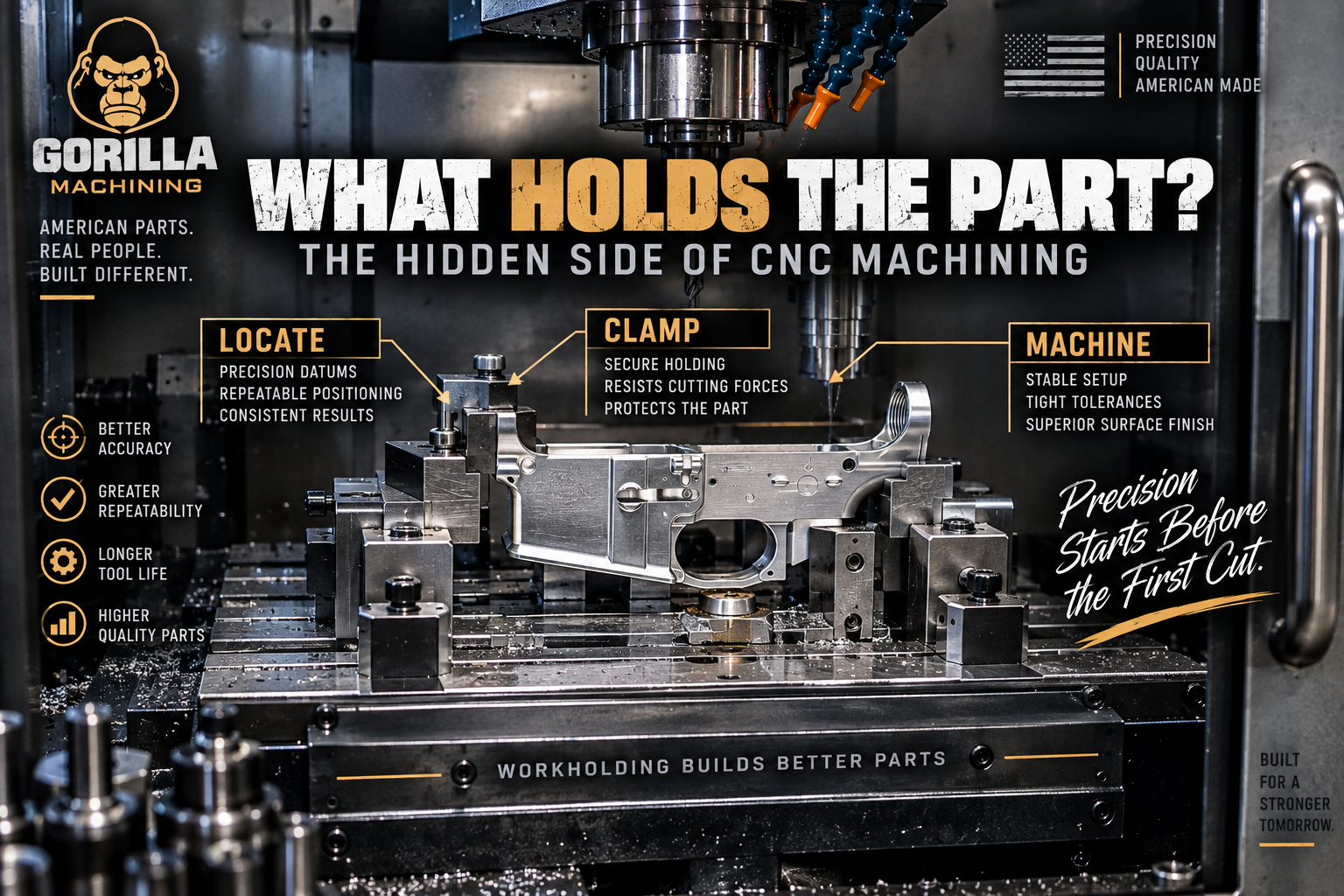
What Is CNC Workholding? How Fixtures Keep AR-15 Parts Precise During Machining
When people watch a CNC machine cutting aluminum, most of the attention goes to the cutting tool.
The spindle is moving.
Metal chips are flying.
Coolant is flowing.
And a raw piece of aluminum gradually begins looking like a finished component.
But there's another part of the process that's just as important.
Something has to hold that aluminum perfectly still.
In machining, that's known as:
WORKHOLDING
Without proper workholding, even an extremely accurate CNC machine can struggle to produce consistent components.
The machine needs to know exactly where the material is located—and the material needs to stay there while cutting forces act against it.
That's where fixtures, vises, jaws, locating features, and careful setup come into play.
What Is CNC Workholding?
Workholding is the general term for the equipment and methods used to secure a workpiece during machining.
A workpiece could be:
An aluminum forging
An extrusion
A piece of billet
Steel bar stock
or a partially machined component.
The goal is to hold that material in a known position while the CNC machine performs its programmed operations.
Why Can't You Just Clamp the Part Down?
Because holding a precision component isn't simply about preventing it from falling out of the machine.
The workholding system needs to accomplish several things at once.
It needs to:
Secure the component
Locate it accurately
Resist cutting forces
Allow cutting-tool access
Avoid damaging the workpiece
and ideally allow the next component to be positioned in nearly the exact same place.
That last requirement is particularly important in production manufacturing.
Location vs. Clamping
These are related, but they're not exactly the same.
Locating
Determines where the component sits.
Clamping
Keeps the component from moving.
A fixture can clamp a part extremely tightly and still produce poor results if the workpiece isn't located correctly.
Precision machining requires both.
What Is a CNC Fixture?
A fixture is a workholding device designed to position and secure a component during manufacturing.
Some fixtures are relatively simple.
Others are highly specialized and designed for one particular product.
A custom fixture might include:
Locating pins
Stops
Clamps
Machined pockets
Support surfaces
and other features.
The fixture becomes part of the manufacturing system.
Why Fixtures Matter for AR Components
AR components can contain complex geometry.
An upper receiver, for example, doesn't look anything like a simple rectangular block once machining begins.
A handguard is long, thin, and hollow.
Other components can have curved surfaces, openings, angled features, and multiple sides requiring machining.
The manufacturer therefore needs a way to securely hold those shapes while still allowing the cutting tools to reach the necessary areas.
What Are Soft Jaws?
One common workholding technique uses:
Soft jaws.
Soft jaws are machinable vise jaws that can be customized to fit a particular workpiece.
Instead of gripping the component between generic flat surfaces, the machinist can machine a profile into the jaws.
That profile can help locate and support the workpiece more effectively.
This is especially useful when holding parts with unusual geometry.
Why Would You Machine the Vise Jaws?
At first this might sound strange.
Why machine the tool that's holding the component?
Because customized jaws can create a repeatable nest for the part.
Imagine trying to securely hold a rounded or irregularly shaped component between two flat pieces of metal.
Now imagine machining the jaws so they match portions of that component's geometry.
The second setup can provide much better support and positioning.
What Is a Datum?
Precision manufacturing frequently uses the term:
DATUM
A datum is a theoretically exact reference used to establish the location or orientation of other features.
In practical manufacturing, physical surfaces or features are used to establish these references.
A CNC setup needs consistent references so the machine knows where the workpiece is positioned.
Without reliable references, dimensions from one operation to another can become inconsistent.
Why Repeatability Matters
Imagine producing one component.
You carefully position the material, machine it, inspect it, and everything is correct.
Now you need to manufacture another 500.
Production manufacturing requires the next piece to sit in the fixture consistently.
Then the next.
And the next.
That's:
Repeatability.
A good workholding system helps make repeatable production possible.
What Are Cutting Forces?
A CNC cutting tool doesn't remove metal without resistance.
As the tool engages the workpiece, forces act on both the cutting tool and the component.
The fixture needs to prevent those forces from moving the workpiece.
If the component shifts—even slightly—the resulting geometry can change.
That's why rigidity is so important.
What Happens If a Part Moves?
Movement during machining can potentially contribute to:
Dimensional errors
Poor surface finish
Chatter
Misaligned features
Tool damage
or a scrapped component.
In severe situations, movement can also create unsafe machining conditions.
Proper workholding helps keep the machining process controlled.
Can You Clamp a Part Too Hard?
Yes.
This is another interesting manufacturing problem.
A thin aluminum component can potentially deform if excessive clamping force is applied.
The machinist therefore needs enough force to hold the component securely without unnecessarily distorting it.
That can be especially important when machining:
Thin walls
Long extrusions
Hollow components
and other relatively flexible geometry.
More clamping force isn't automatically better.
Why Handguards Can Be Challenging
Our previous blog discussed how aluminum handguards can begin as extrusions.
Those extrusions can be relatively long and thin.
Now imagine machining slots along the entire length.
If the extrusion isn't adequately supported, cutting forces can potentially cause vibration or deflection.
The workholding system therefore has to support the component while leaving the areas being machined accessible.
This is where fixture design becomes extremely important.
What Is Part Deflection?
Metal may feel completely rigid in your hand.
But under machining forces, components and cutting tools can experience extremely small amounts of movement.
This is called:
Deflection.
We're often talking about movement far too small to notice visually.
But when you're manufacturing components to tight tolerances, tiny movements can matter.
Why Multiple Setups Are Needed
A CNC cutting tool can't always reach every feature of a complex component from one direction.
That means the part may need to be repositioned.
For example:
OPERATION 1
Machine features accessible from the first orientation.
Then:
OPERATION 2
Remove the component and hold it in another orientation.
Additional setups may follow depending on the component and equipment.
The Challenge of the Second Operation
This is where precision workholding becomes especially interesting.
The first machining operation creates certain features.
Now the component is moved.
The second fixture needs to locate the partially machined component so new features line up correctly with the first operation.
If that relationship isn't controlled, features from different setups can become misaligned.
Op 1 and Op 2
Inside machine shops, you'll often hear terms such as:
OP 1
and
OP 2
These simply refer to different manufacturing operations or setups.
A complex component may have:
OP 1
OP 2
OP 3
and additional secondary operations.
Each stage progressively transforms the material into the final component.
Why 5-Axis Machining Can Help
Some modern CNC machining centers can move a component or cutting tool through additional axes.
Five-axis machining can allow cutting tools to reach more sides of a component without manually repositioning it as often.
That can potentially reduce the number of setups required for certain components.
But five-axis machining doesn't eliminate workholding.
The component still needs to be located and secured.
What Is Zero-Point Workholding?
Advanced manufacturing environments sometimes use standardized quick-change workholding systems designed to locate fixtures very repeatably.
These systems can help manufacturers move fixtures or components while maintaining consistent positioning.
The goal is to reduce setup time without sacrificing repeatability.
This can be particularly valuable in production environments where machines manufacture multiple products.
Workholding and Surface Finish
Poor workholding doesn't only affect dimensions.
It can also affect how a machined surface looks.
If a component vibrates during machining, the cutting tool may leave an undesirable repeating pattern.
As we discussed in our CNC tool-mark article, this can contribute to:
Chatter.
Good workholding helps create a stable cutting environment.
Workholding and Tool Life
The cutting tool also benefits from stability.
Uncontrolled vibration can increase stress on tooling.
A stable workpiece allows the cutting tool to operate under more predictable conditions.
That can contribute to better:
Surface finish
Tool life
Dimensional consistency
and overall process reliability.
How Fixtures Are Designed
Fixture design involves balancing multiple requirements.
The fixture needs to hold the component securely while allowing access to the features being machined.
Engineers and machinists consider questions such as:
Where can the part be supported?
Where can it be clamped?
Which surfaces establish location?
Will the cutting tool have enough clearance?
Can chips escape?
Will coolant reach the cutting area?
Can the component be loaded repeatedly?
A good fixture solves all of these problems at once.
Chip Evacuation Matters
CNC machining produces chips.
Lots of them.
A fixture shouldn't create areas where chips repeatedly become trapped against important locating surfaces.
If chips get between the workpiece and its locating surface, they can potentially prevent the next component from sitting correctly.
That's why operators keep workholding surfaces clean between cycles.
A tiny aluminum chip can matter when you're working in thousandths of an inch.
Why Cleanliness Is Part of Precision
Imagine a tiny chip sitting underneath a workpiece.
The next component is loaded on top of it.
Now the component isn't sitting exactly where the fixture expects.
The CNC machine doesn't necessarily know that.
It simply runs the program.
This demonstrates an important lesson:
Precision manufacturing isn't only about expensive machines.
Process discipline matters too.
Fixtures Can Wear Out
Fixtures aren't immune to wear.
Locating surfaces, clamps, jaws, and other features can experience repeated use.
Production manufacturers therefore need to monitor the condition of their workholding equipment.
A fixture that was perfect when it was built can eventually require maintenance or replacement.
Again, process control never really stops.
Workholding and Quality Control
If inspection shows a feature drifting out of tolerance, the cutting tool isn't the only thing manufacturers investigate.
They may also examine:
Fixture condition
Clamping
Locating surfaces
Tool wear
Machine offsets
and the raw material itself.
Manufacturing is a system.
One measurement can be influenced by several different variables.
Why You Don't See Fixtures on the Finished Product
The customer sees the finished component.
They don't see the:
Fixtures
Soft jaws
Setup blocks
Locating pins
Clamps
CNC programs
or inspection equipment used to produce it.
But all of those things contribute to what eventually goes into the box.
That's part of what makes manufacturing fascinating.
Frequently Asked Questions
What is CNC workholding?
Workholding refers to the equipment and methods used to locate and secure material or components during machining.
What is a CNC fixture?
A fixture is a device designed to position and hold a workpiece during a manufacturing operation.
What are soft jaws?
Soft jaws are machinable vise jaws that can be customized to better support and locate a particular component.
Why can't a CNC part be machined in one setup?
Complex geometry can make certain features inaccessible from a single orientation, requiring the component to be repositioned for additional operations.
What are OP 1 and OP 2?
They commonly refer to separate manufacturing operations or setups performed during production.
Can excessive clamping damage aluminum?
Excessive or poorly applied clamping force can potentially distort relatively thin or flexible components, which is why workholding must be carefully designed.
Does workholding affect CNC tolerances?
Yes. Stable, repeatable positioning is an important part of maintaining dimensional consistency during machining.
Conclusion
When you watch a CNC machine run, the cutting tool gets all the attention.
But precision machining depends just as heavily on what's holding the component.
A properly designed workholding system helps control:
Location
Movement
Vibration
Repeatability
Alignment
and ultimately dimensional accuracy.
The CNC machine may know exactly where it wants to cut.
But that only works if the component is exactly where the machine expects it to be.
Precision starts before the cutting tool ever touches the metal.
And that's why good fixtures are one of the unsung heroes of CNC manufacturing.

