
Absolutely. Since we just finished AR-10 vs. LR-308, let's keep moving into topics we haven't already covered.
What Is Barrel Concentricity? Why Alignment Matters in Firearm Manufacturing
Search Intent
People searching for barrel concentricity, bore concentricity, or what concentricity means on a firearm barrel are usually trying to understand how accurately the bore, chamber, muzzle, threads, and other barrel features align with one another.
This article explains concentricity from a manufacturing and quality-control perspective—what it means, how machinists evaluate it, and why precision machining matters.
What Is Barrel Concentricity?
When customers compare barrels, they usually look at specifications such as:
Caliber. Barrel length. Twist rate. Steel. Finish. Profile.
But there's another manufacturing concept that's much harder to see in a product photo:
Concentricity.
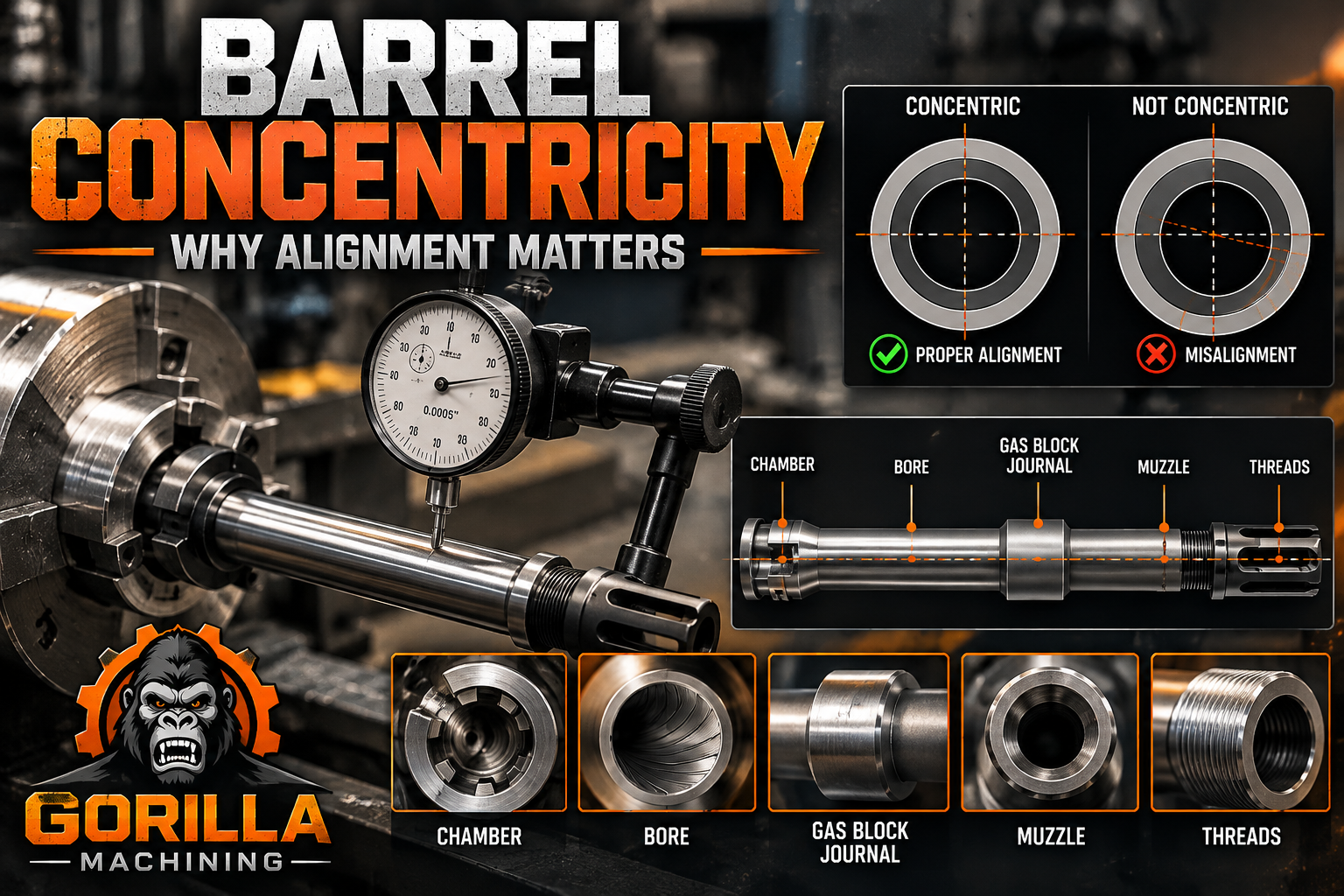
In simple terms, concentricity describes how closely features that are intended to share a common centerline actually align with one another.
For a barrel, manufacturers have several important features to control, including the bore, chamber, exterior surfaces, muzzle, and—where applicable—threaded features.
A barrel can look perfectly straight from the outside while the important question for a machinist is:
Are the critical features properly aligned to their intended reference geometry?
That's where precision manufacturing and inspection come in.
Think of It Like Circles Inside Circles
Imagine drawing one circle on a piece of paper.
Now draw another circle around it.
If both circles have exactly the same center point, they're concentric.
Move the center of the second circle slightly to one side and they're no longer perfectly concentric.
A machined barrel is obviously much more complicated, but the basic concept is similar.
Features designed around a common axis need to be machined and inspected according to the engineering requirements for that component.
Concentricity vs. Straightness
These terms sometimes get mixed together.
A feature being straight doesn't necessarily tell you whether another feature is concentric with it.
Likewise, concentricity is not simply a visual measurement of whether a barrel “looks straight.”
Manufacturing drawings establish the relevant dimensions, datums, tolerances, and geometric relationships that need to be controlled.
What Is Runout?
Another term you'll hear in machining is runout.
Runout is a practical way of evaluating how much a surface or feature varies as the component rotates around a reference axis.
A machinist can rotate a component while using precision measuring equipment to observe the amount of variation.
Excessive runout can indicate that a feature isn't aligned as intended.
Concentricity and runout are related concepts, but they're not technically identical measurements.
Why Barrel Manufacturing Requires Precision
A barrel contains multiple precision features that have to work together.
Depending on the design, these may include:
- Bore
- Rifling
- Chamber
- Barrel extension interfaces
- Gas-block journal
- Muzzle
- Threaded features
- Exterior profile
Each feature has its own manufacturing requirements.
This is why making a quality barrel involves much more than drilling a long hole through a piece of steel.
The Bore Establishes an Important Reference
The bore is one of the most important features of any barrel.
During different manufacturing operations, manufacturers use appropriate tooling, fixtures, and reference surfaces to control the relationship between the bore and other features.
The exact manufacturing sequence varies depending on the barrel design and production method.
The important takeaway is that the relationships between features matter—not simply their individual dimensions.
Why Muzzle Threads Get So Much Attention
Customers often hear the term concentricity when discussing threaded muzzles.
That's because a threaded feature has both dimensional requirements and an alignment relationship with the barrel.
From a manufacturing perspective, properly produced threads require control over characteristics such as:
- Diameter
- Pitch
- Thread form
- Shoulder geometry
- Alignment
Simply seeing clean-looking threads doesn't verify all of those characteristics.
That's why manufacturers use appropriate inspection methods rather than relying only on visual appearance.
How Manufacturers Check Alignment
Machine shops have several inspection methods available depending on the feature, drawing, and tolerance being evaluated.
These can include:
Dial indicators — useful for evaluating runout as a component rotates.
Precision gauges — used for checking specific dimensions and features.
Micrometers — provide highly accurate dimensional measurements.
Inspection fixtures — allow components to be held from controlled reference points.
Coordinate measuring equipment — can evaluate more complex geometric relationships when appropriate.
The inspection method should match the specification being checked.
The Role of CNC Machining
Modern CNC equipment provides manufacturers with tremendous control over machining operations.
But the machine itself is only part of the equation.
Manufacturing consistency also depends on:
Tooling. Fixturing. Programming. Material. Machine condition. Inspection. Operator experience.
That's why quality manufacturing still requires skilled machinists and quality-control procedures even with modern automated equipment.
Why Tooling Matters
Cutting tools wear during production.
A fresh tool and a heavily worn tool don't necessarily behave identically.
Manufacturers therefore monitor tooling and finished dimensions throughout production.
Depending on the operation, tooling may be replaced or machine offsets adjusted before the process drifts outside the specified tolerance.
This is one reason in-process inspection is such an important part of precision manufacturing.
Barrel Concentricity and Quality Control
Concentricity is a great example of something customers usually can't judge simply by looking at a product.
A beautiful surface finish doesn't tell you everything about the geometry underneath it.
Quality control therefore focuses on measurable specifications.
The goal isn't simply:
“Does it look right?”
It's:
“Does it measure correctly according to the applicable specifications?”
Frequently Asked Questions
What does barrel concentricity mean?
Generally, it refers to the alignment of barrel features that are intended to share or relate to a common axis.
Is concentricity the same as runout?
No. They're related concepts, but runout measures variation observed as a component rotates relative to a reference axis, while concentricity describes a geometric relationship between centers or axes.
Can you tell if a barrel is concentric just by looking at it?
Not reliably. Precision alignment is evaluated using appropriate measuring and inspection equipment.
Does CNC machining automatically guarantee concentricity?
No. CNC equipment is capable of highly precise work, but results still depend on programming, tooling, workholding, machine condition, process control, and inspection.
Why do manufacturers inspect barrels during production?
Inspection allows manufacturers to verify that critical features remain within their specified dimensions and tolerances throughout a production run.
Manufacturing Is About What You Can't See
Some of the most important characteristics of a machined component aren't obvious from the outside.
Customers see the finished barrel.
A machinist sees dimensions, centerlines, tolerances, surface finishes, tooling, and inspection results.
That's the difference between simply making something that looks like a barrel and manufacturing a component to an engineering specification.
At Gorilla Machining, those behind-the-scenes manufacturing details are worth understanding because they help customers make more informed decisions about the components they're purchasing.
GORILLA MACHINING
More Than Parts. A Higher Standard.

