
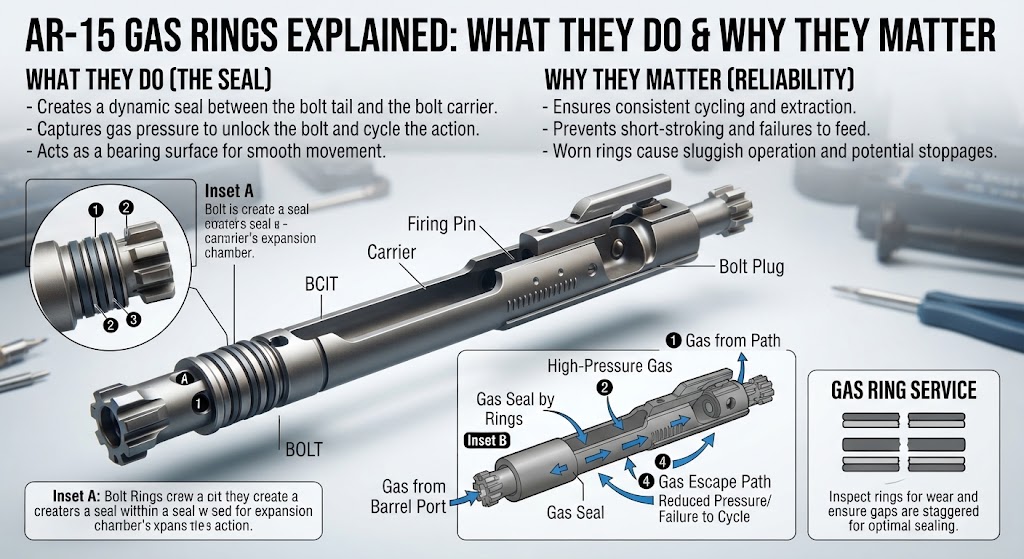
Why Do AR-15 Bolts Have Gas Rings?
Some of the smallest components in an AR-15 perform surprisingly important jobs.
A perfect example is the set of gas rings located around the rear portion of the bolt.
They're easy to overlook. They're inexpensive, small, and mostly hidden inside the bolt carrier group.
But they're an important part of how a traditional direct-gas AR operating system functions.
So what exactly are AR-15 gas rings doing inside the bolt carrier group?
Where Are the Gas Rings Located?
The gas rings sit in grooves around the rear portion of the AR-15 bolt.
When the bolt is installed inside the carrier, these rings interact with the internal surface of the bolt carrier.
Their purpose is similar in concept to piston rings inside an engine: they help create a controlled gas seal while still allowing the bolt to move within the carrier.
That combination—sealing while permitting movement—is what makes them interesting.
What Happens When the AR-15 Cycles?
When an AR-15 fires, expanding gas is routed through the firearm's gas system and into the carrier.
Inside the bolt carrier group, that gas pressure acts on the bolt/carrier assembly.
The gas rings help limit gas leakage around the rear portion of the bolt so pressure can act on the system as designed.
The bolt carrier begins moving rearward while the bolt initially remains locked.
The geometry of the carrier and cam pin then causes the bolt to rotate and unlock from the barrel extension.
From there, the operating cycle continues.
The gas rings are only one part of this system, but they play an important role in managing the gas pressure inside the carrier.
Why Are There Multiple Gas Rings?
A typical AR-15 bolt uses three separate gas rings.
Using multiple rings provides overlapping sealing surfaces around the bolt.
You may have heard the old advice that the gaps in all three rings must be perfectly staggered.
That subject has generated plenty of discussion among AR owners.
The more important issue from a maintenance standpoint is whether the rings collectively provide the required sealing function and remain serviceable—not obsessively repositioning them every time the bolt is cleaned.
Gas Rings Are Wear Components
Gas rings aren't intended to last forever.
Every time the firearm cycles, the bolt moves relative to the carrier.
Over time, friction, heat, fouling, and normal operation can contribute to wear.
Eventually, gas rings may require replacement as part of routine bolt-carrier-group maintenance.
That's not necessarily an indication that anything was manufactured incorrectly.
Some firearm components are simply wear items.
What Are AR-15 Gas Rings Made From?
Gas rings are typically manufactured from spring-type steel selected to maintain tension while repeatedly operating inside the carrier.
They need enough outward tension to maintain contact with the carrier's internal surface while still allowing the bolt to move correctly.
That makes their dimensions and material properties important despite their extremely simple appearance.
Gas Rings vs. One-Piece Designs
Traditional AR bolts commonly use three individual gas rings, but aftermarket one-piece gas-ring designs also exist.
The concept is similar: create the necessary seal between the bolt and carrier while allowing the assembly to move.
A one-piece design doesn't automatically mean an AR will perform better than a properly functioning traditional three-ring system.
For most owners, the important consideration is whether the components are compatible and operating within the manufacturer's specifications.
Can Gas Rings Cause Cycling Problems?
Worn, damaged, incorrectly specified, or improperly installed components can potentially contribute to operating issues.
However, AR cycling problems can have many possible causes.
Gas-system components, ammunition, magazines, lubrication, springs, buffers, carrier components, and other factors can all influence operation.
That's why replacing parts based on a single symptom isn't always the best diagnostic approach.
Proper troubleshooting looks at the complete system.
Why Lubrication Matters
The bolt and carrier contain metal surfaces that move against one another during operation.
Appropriate lubrication according to the firearm or component manufacturer's recommendations helps reduce unnecessary friction and wear.
Gas rings should also be inspected when the bolt carrier group is being cleaned.
Look for obvious signs of damage, unusual deformation, or excessive wear.
Gas Rings Are a Great Example of AR Engineering
One reason the AR platform is interesting from a mechanical perspective is how many relatively simple components work together.
Gas rings don't look particularly impressive sitting on a workbench.
They're just small pieces of metal.
Inside the operating system, however, they're helping manage gas pressure while allowing the bolt to move inside the carrier.
That's a lot of responsibility for three tiny rings.
Frequently Asked Questions
What do AR-15 gas rings do?
They help form a gas seal between the bolt and the inside of the bolt carrier while allowing the bolt to move within the carrier.
How many gas rings does an AR-15 bolt have?
Traditional AR-15 bolts commonly use three gas rings.
Do AR-15 gas-ring gaps need to be perfectly staggered?
You may encounter advice about staggering the gaps, but routine maintenance should focus on the condition and proper function of the complete gas-ring system and follow the component manufacturer's guidance.
Do gas rings wear out?
Yes. Gas rings are wear components and may eventually require replacement.
Are AR-15 and AR-10 gas rings the same?
Compatibility can vary depending on the specific bolt and platform. Don't assume a gas ring intended for one bolt assembly fits another; check the manufacturer's specifications.
Are one-piece gas rings better?
They're an alternative design. A properly functioning traditional three-ring system can also perform its intended function. Compatibility and proper dimensions are more important than assuming one design is universally superior.
Small Component, Important Job
Gas rings are a perfect example of why every component inside an AR has a purpose.
They're small enough to disappear on a workbench, but inside the bolt carrier group they contribute to the gas-management process that allows the action to operate.
Understanding components like these gives firearm owners a better understanding of how the AR platform works mechanically, rather than simply knowing the names of its major parts.
At Gorilla Machining, we believe understanding the components inside your firearm is just as important as understanding the parts you can see from the outside.
GORILLA MACHINING
More Than Parts. A Higher Standard.

