
What Is a Barrel Chamber?
When shopping for an AR barrel, you'll see specifications such as:
5.56 NATO
.223 Remington
.223 Wylde
.300 Blackout
.308 Winchester
8.6 Blackout
We often refer to these as the caliber or chambering of a barrel, but what exactly is the chamber?
The chamber is the precisely machined portion of the barrel where the cartridge is positioned for firing.
It's located at the breech end of the barrel, immediately before the rifled portion of the bore.
Although it may look like a simple opening, a chamber contains carefully controlled dimensions that are critical to the firearm's design.
Chamber vs. Bore: What's the Difference?
These terms are sometimes confused.
The chamber is the area designed to accept the cartridge.
The bore continues forward through the barrel and contains the rifling that interacts with the projectile.
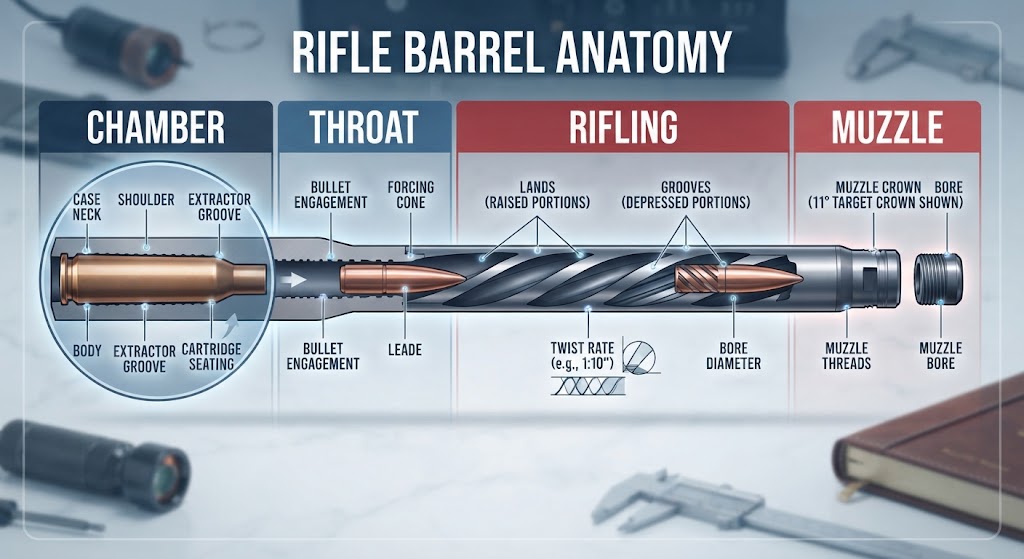
Think of the barrel as having different sections:
Chamber ? Throat/Leade ? Rifling ? Muzzle
Each section has a different job.
The Chamber
This area corresponds to the cartridge case and establishes important dimensional relationships when the action is locked.
The Throat and Leade
Immediately ahead of the chamber is the transition into the rifling.
This region includes what is commonly called the throat or leade.
Its geometry varies by chamber specification.
The Rifling
Farther down the barrel are the lands and grooves that impart spin to the projectile.
That's where specifications such as 1:7, 1:8 and 1:9 twist rates come into play.
How Is a Barrel Chamber Made?
During barrel manufacturing, the chamber must be machined to the specifications required for the intended cartridge.
A specialized cutting tool called a chamber reamer is commonly used to produce the chamber geometry.
The reamer incorporates the required profile so the manufacturer can machine features such as the cartridge-body area, shoulder and neck region according to the applicable design.
This is precision machining.
Removing too little or too much material can change critical dimensional relationships.
That's why tooling condition, machine setup and inspection are important parts of barrel manufacturing.
Why Chamber Reamers Matter
A chamber reamer isn't simply a drill bit.
It's a precision cutting tool designed around a particular chamber specification.
Different cartridges require different chamber geometry.
Even cartridges that appear extremely similar externally can have differences in their chamber specifications.
One familiar AR-platform example is:
.223 Remington vs. 5.56 NATO vs. .223 Wylde
We've previously discussed the ammunition differences, but the chamber geometry inside the barrel is an important part of why those markings matter.
What Is Headspace?
You can't discuss chambers without mentioning headspace.
Headspace refers to a specific dimensional relationship between the chamber and the locked breech/bolt system, defined according to the cartridge design.
It's not simply “empty space” inside the chamber.
Manufacturers use appropriate gauges and inspection procedures to verify critical dimensions during production and assembly.
Proper headspace is a fundamental part of firearm design and manufacturing.
Why Two Chambers Can Look Identical
If you looked inside two barrels, you might not visually notice a difference between their chambers.
That's because many of the differences we're discussing are measured very precisely.
A chamber isn't identified by looking at it and saying:
“That looks like a 5.56 chamber.”
Manufacturers rely on engineering specifications, tooling and inspection.
This is another example of why firearm manufacturing involves so much that the customer never sees.
What Does .223 Wylde Actually Mean?
The .223 Wylde chamber is an especially good example of how chamber design can cause confusion.
It isn't a new cartridge.
A shooter doesn't buy a box of “.223 Wylde ammunition.”
Instead, .223 Wylde describes the chamber design.
It was developed to accommodate .223 Remington and 5.56 NATO ammunition while using chamber geometry intended to combine desirable characteristics of the two established chamber designs.
That distinction is why the marking on the barrel matters.
Chambering Is Different From Twist Rate
Another common misconception is that chambering and twist rate describe the same thing.
They don't.
For example, a barrel might be:
Chamber: 5.56 NATO
Twist: 1:7
The chamber specification describes the cartridge interface at the rear of the barrel.
The twist rate describes how quickly the rifling rotates as it travels down the bore.
Both are important barrel specifications, but they describe completely different characteristics.
Chambering Is Different From Barrel Length
Barrel length doesn't determine chambering either.
You can find barrels of different lengths chambered for the same cartridge.
Likewise, two barrels of identical length may be designed for completely different cartridges.
That's why customers should look at the complete barrel specifications rather than assuming compatibility from appearance.
Why Barrel Markings Matter
Many barrels include markings identifying important specifications such as chambering and twist rate.
Those markings give the owner a permanent reference for identifying the barrel.
That's particularly useful because once a barrel is installed, the chamber itself doesn't provide an obvious visual indication of exactly what specification it was machined to.
Never identify chambering solely by appearance.
Chamber Manufacturing and Quality Control
A properly manufactured chamber depends on more than having the correct reamer.
Manufacturers also have to consider:
Machine setup
Tool condition
Cutting parameters
Lubrication/coolant
Material characteristics
Dimensional inspection
Surface finish
As a reamer is used, it experiences wear like other cutting tools.
Tool condition therefore has to be monitored during manufacturing.
The finished chamber can then be inspected using the appropriate gauges and quality-control procedures for the product.
Frequently Asked Questions
Is the chamber the same thing as the barrel?
No. The chamber is one specifically machined area inside the breech end of the barrel.
Is chambering the same as caliber?
The terms are often used casually together, but chambering provides more specific information about the cartridge the barrel is designed around.
Where is the chamber located?
At the breech end of the barrel, where the cartridge is positioned when the firearm is in battery.
What tool is used to make a chamber?
A precision chamber reamer is commonly used during barrel manufacturing.
Is .223 Wylde ammunition?
No. .223 Wylde is a chamber specification, not an ammunition cartridge.
Is twist rate part of the chamber?
No. Twist rate describes the rifling inside the bore.
More Than a Hole in a Barrel
The chamber is one of those firearm features that most owners rarely see clearly, yet it's one of the most precisely controlled areas of a barrel.
What appears to be a simple opening actually contains carefully engineered geometry designed around a specific cartridge.
And that's what makes barrel manufacturing interesting.
From the chamber and throat to the rifling and crown, every section of a barrel has its own purpose.
At Gorilla Machining, understanding those manufacturing details helps customers understand what they're actually looking at when they compare barrel specifications.

