
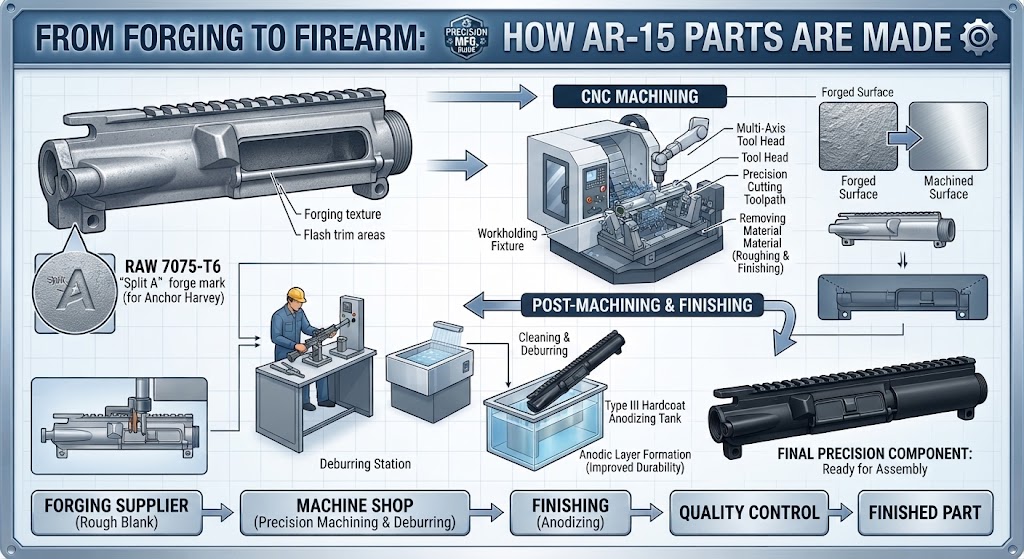
How AR-15 Parts Are Made From Forgings
When you look at a finished AR-15 upper receiver, it's easy to assume it started as a solid piece of aluminum that was simply placed into a CNC machine.
Many receivers don't begin that way.
They begin as something much rougher:
An aluminum forging.
At first glance, a raw forging may already resemble the component it will eventually become.
But it's far from finished.
Critical surfaces, holes, threads, openings, and other features still have to be precisely machined.
So how does a rough piece of forged aluminum become the clean, precise component you see on a finished firearm?
It begins long before the CNC machine starts cutting.
What Is Forging?
Forging is a manufacturing process in which metal is shaped using compressive force.
Rather than removing most of the material from a rectangular block, the material is formed into a shape closer to the final component.
In aluminum forging, manufacturers use specialized tooling and significant pressure to form heated or otherwise appropriately processed aluminum into the desired shape.
The result is known as a:
Forging blank.
For an AR receiver, that blank already has the rough outline of a receiver.
But it isn't ready to use.
A Forging Is Not a Finished Receiver
This is one of the most important distinctions for customers to understand.
A forging provides the basic material and external shape.
Precision machining creates the final features.
A raw forging may still require numerous CNC operations before becoming a finished component.
Conceptually, the process looks like:
ALUMINUM ? FORGING ? CNC MACHINING ? DEBURRING ? INSPECTION ? FINISHING ? FINAL COMPONENT
Each stage has a different purpose.
Why Forge Aluminum in the First Place?
One reason manufacturers use forging is the way the process shapes the metal.
When metal is forged, its internal grain structure follows the general geometry produced by the forging process.
This can provide excellent mechanical properties when the material and process are properly engineered.
Forging can also produce a starting shape that is much closer to the finished component than a large rectangular billet.
That means less material may need to be removed during subsequent machining.
What Is 7075-T6?
For AR receivers, one of the most familiar material specifications is:
7075-T6 aluminum.
The 7075 identifies the aluminum alloy.
The T6 identifies a heat-treatment condition.
7075 is a high-strength aluminum alloy widely used in applications where strength-to-weight performance is important.
But there's an important distinction:
7075-T6 tells you the material and temper—not how the finished component was machined.
A manufacturer still has to transform that material into a correctly dimensioned component.
What Does the Forging Look Like Before Machining?
A receiver forging can look surprisingly rough compared with a finished product.
You may see:
Rounded surfaces
Forging seams
Flash or trimmed areas
Textured surfaces
Extra material
and features that haven't yet been machined.
This isn't poor workmanship.
The forging is intentionally created with material available for later machining operations.
What Is Forging Flash?
During certain forging processes, a small amount of metal can be forced outward between the dies.
This excess material is commonly called:
Flash.
Manufacturing operations remove the unwanted excess as part of producing the forging.
Evidence of the forging process may still be visible on areas that aren't subsequently machined away.
This helps explain why forged and fully machined surfaces can have noticeably different textures on the same component.
What Is a Forge Mark?
Many AR owners have noticed symbols on forged upper receivers.
Common examples include shapes or symbols associated with particular forging suppliers.
These are generally referred to as:
Forge marks.
A forge mark can help identify the company that produced the original forging.
However, it doesn't necessarily identify the company that performed the final CNC machining.
This is an important distinction.
Forging supplier ? necessarily finished-part manufacturer.
One company may create the raw forging while another performs the machining, finishing, inspection, branding, and sale of the finished component.
Anchor Harvey and the “Split A”
One forge mark familiar to many AR enthusiasts is associated with Anchor Harvey.
The company's forging identification is commonly recognized by AR enthusiasts as a stylized or split “A” marking.
A receiver carrying that mark indicates the origin of the forging.
It doesn't automatically tell you who completed every subsequent manufacturing operation.
That's why evaluating the finished component requires looking beyond the forge mark alone.
What Happens When the Forging Reaches the Machine Shop?
Now the transformation begins.
The forging must be positioned accurately in specialized workholding equipment.
The CNC machine then removes material according to the engineering requirements for the component.
Different areas may require different tools and machining operations.
A single component can therefore go through multiple setups before it's complete.
Why Are Multiple CNC Setups Necessary?
A CNC machine can only reach features that are accessible from its current setup.
Imagine trying to machine every side of a complex three-dimensional component without ever repositioning it.
That's not always practical.
Manufacturers may therefore use multiple fixtures and setups.
One setup might expose one group of surfaces.
Another setup allows the machine to access another side.
Each repositioning must be controlled carefully so the features created in different operations remain correctly located relative to one another.
Why Workholding Is So Important
Before cutting begins, the forging needs to be held securely.
This is called:
Workholding.
Fixtures must locate the forging consistently while keeping it rigid during machining.
Poor workholding can contribute to:
Movement
Vibration
Dimensional inconsistency
and poor surface finish.
A good fixture isn't merely something that holds the component down.
It's part of the precision manufacturing system.
Roughing vs. Finishing Operations
CNC machining often uses different operations for removing material.
Roughing
Roughing operations remove larger amounts of material efficiently.
The goal is to get close to the final geometry.
Finishing
Finishing operations remove smaller amounts of material to establish final dimensions and surface quality.
This is similar to sculpting.
You don't necessarily create the final surface with the first cut.
Material is removed strategically until the required geometry is achieved.
Different Tools Perform Different Jobs
One component can require many types of cutting tools.
Manufacturers may use tools designed for operations such as:
Facing
Milling
Drilling
Boring
Threading
Chamfering
and engraving.
Each tool has a specific purpose.
The CNC program determines how those tools move through the machining operation.
Why Tool Changes Matter
Modern CNC machining centers can hold numerous cutting tools.
During a manufacturing cycle, the machine can automatically switch between them.
One tool might remove a large amount of aluminum.
Another creates a smaller feature.
Another handles a threaded area.
Another creates a finished edge.
This allows a complicated component to undergo many manufacturing operations within a controlled CNC process.
From Forged Surface to Machined Surface
This is one of the easiest manufacturing characteristics to see on a raw receiver.
Some surfaces may retain their original forged texture.
Other surfaces have been completely machined.
The difference can be obvious.
A forged surface may appear slightly textured.
A machined surface may display fine CNC toolpaths.
Neither is automatically a defect.
They're evidence of two different manufacturing processes used on the same component.
Why Not Machine Everything Away?
If a forged surface already meets the design requirements, machining it purely for appearance may add unnecessary production time and cost.
Manufacturers generally machine the areas that require precise geometry or a specified surface.
That's one reason a forged component can retain recognizable forging texture in certain noncritical areas.
When Deburring Comes In
Once the primary CNC operations are complete, the component can still contain small burrs along machined edges.
That's where the process from our previous blog comes in:
Deburring.
Unwanted sharp material is removed while intentional geometry is maintained.
This prepares the component for inspection and subsequent finishing operations.
Inspection Comes Next
A component isn't considered correct simply because the CNC machine finished its program.
Critical dimensions still need to be verified.
Depending on the feature, manufacturers may use:
Calipers
Micrometers
Pin gauges
Thread gauges
Height gauges
Optical inspection equipment
or coordinate measuring equipment.
The specific inspection method depends on the engineering requirements.
Why Tolerances Matter
This connects directly with another part of our manufacturing series.
Every machined feature isn't expected to hit one mathematically perfect dimension.
Engineering drawings establish allowable ranges known as:
Tolerances.
The machining process must keep critical features within those allowable limits.
That's why professional CNC manufacturing combines:
Programming + Tooling + Workholding + Measurement + Process Control
The machine itself is only one part of the equation.
What Happens Before Anodizing?
Once machining and required preparation are complete, an aluminum component may move into finishing.
For many AR components, that means:
Type III hardcoat anodizing.
The surface must be properly prepared before the anodizing process.
Anodizing doesn't replace machining or magically correct dimensional errors.
The component should already have the required geometry before final finishing.
Raw vs. Anodized Forged Components
A raw component gives you a particularly clear look at the manufacturing process.
You may be able to see:
Original forging texture
CNC toolpaths
Machined edges
Deburred areas
and transitions between forged and machined surfaces.
After anodizing, the component takes on a more uniform finished appearance.
But underneath that finish is all of the machining work that created the component.
Forged vs. Billet: Don't Confuse the Terms
Another common misunderstanding involves:
FORGED
and
BILLET.
These terms describe how the starting material or component form was produced—not simply whether CNC machinery was involved.
A forged receiver still requires extensive machining.
A billet receiver is also CNC machined, but it typically begins from billet or bar/plate stock rather than a near-net-shape forging.
So:
Forged does not mean “not CNC machined.”
A forged receiver can still spend considerable time inside a CNC machining center.
Does a Forge Mark Determine Quality?
Not by itself.
A quality forging is an important starting point.
But the final component still depends on what happens afterward.
Consider:
Machining
Tooling
Workholding
Dimensional control
Deburring
Surface preparation
Finishing
and
Quality inspection.
A forge mark tells you something about where the starting forging came from.
It doesn't tell the entire manufacturing story.
The Manufacturing Journey
Here's the big picture:
1. Aluminum material is prepared.
?
2. The forging supplier forms the rough component.
?
3. Excess material is trimmed and the forging prepared.
?
4. The forging arrives at the machining operation.
?
5. CNC equipment machines critical features.
?
6. The component is deburred and prepared.
?
7. Critical dimensions are inspected.
?
8. Surface finishing is applied.
?
9. Final quality control is performed.
?
FINISHED COMPONENT
What looks simple on a store shelf represents multiple specialized manufacturing processes.
Frequently Asked Questions
Is a forged AR receiver already finished when it leaves the forge?
No. The forging provides the rough form. Significant machining and finishing are still required before it becomes a finished component.
Are forged AR parts CNC machined?
Yes. Forging and CNC machining aren't mutually exclusive. A forged receiver generally requires precision machining to create its final features.
What does 7075-T6 mean?
7075 identifies the aluminum alloy, while T6 identifies its heat-treatment condition.
What is an AR-15 forge mark?
A forge mark is an identifying mark associated with the company that produced the original forging.
Does the forge mark identify who machined the receiver?
Not necessarily. The forging supplier and the company performing final machining can be different.
Why can I see rough areas on a raw forged component?
Some areas may retain their original forging texture while other surfaces have been CNC machined.
Is forged automatically better than billet?
Neither term alone determines overall quality. Material selection, engineering, machining, finishing, and quality control all matter.
Conclusion
A finished AR component can look deceptively simple.
But before that component reached the customer, it may have gone through:
Forging
CNC machining
Multiple setups
Tool changes
Deburring
Inspection
Surface preparation
and
Anodizing.
That's why a forging is only the beginning.
The forging provides the foundation.
Precision machining turns that foundation into the finished component.
Understanding the process gives you a much better appreciation for what you're actually looking at when you pick up a quality machined part.

