
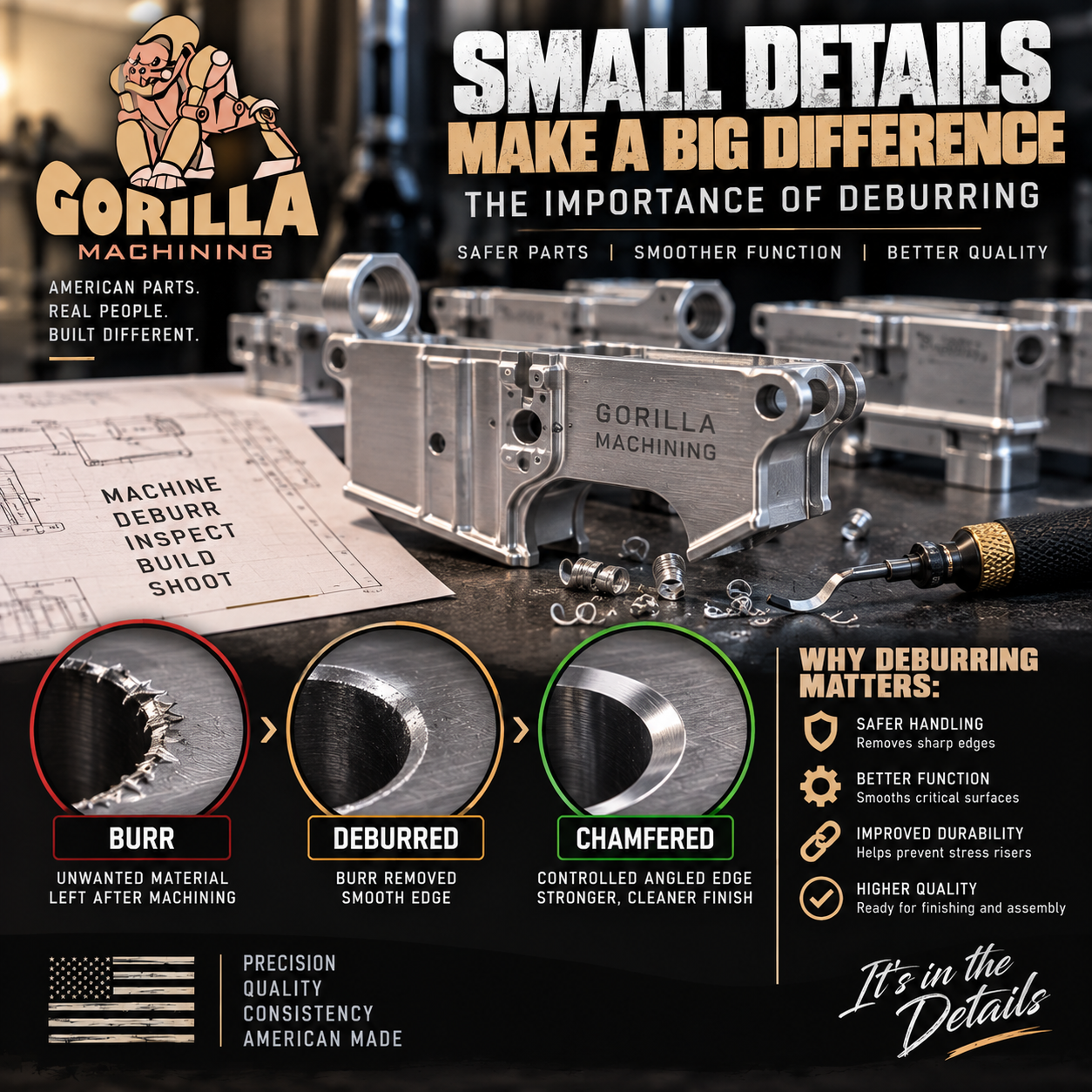
What Is CNC Deburring? Why It Matters on AR-15 Parts
When people think about CNC machining, they usually picture a cutting tool carving a finished component from aluminum or steel.
But when the CNC machine stops, the manufacturing process isn't necessarily finished.
Freshly machined components can have tiny pieces of material remaining along edges, holes, slots, or intersecting features.
These are called:
BURRS
Removing them is known as deburring.
It may sound like a small detail, but deburring is an important part of producing a properly finished precision-machined component.
What Is a Burr?
A burr is an unwanted projection or raised edge of material created during a manufacturing operation.
When a cutting tool removes material, the metal doesn't always separate perfectly at every edge.
A very small amount can remain attached.
Depending on the operation, burrs can form around:
Drilled holes
Milled pockets
Slots
Cross holes
Threads
Edges
and other machined features.
Some burrs are easy to see.
Others are so small that they're easier to feel than see.
Why Does CNC Machining Create Burrs?
Even with modern CNC equipment and high-quality cutting tools, burr formation is a normal consideration in metalworking.
Several factors can influence burr formation, including:
Material
Cutting-tool geometry
Tool condition
Cutting direction
Feed rate
Machining operation
and the geometry of the component itself.
Different materials also behave differently when they're cut.
Aluminum, carbon steel, stainless steel, and other alloys don't necessarily produce identical burr characteristics.
Does a Burr Mean the CNC Machine Did Something Wrong?
Not necessarily.
Burr formation is a normal phenomenon in machining.
The important question is what happens after machining.
Professional manufacturing processes anticipate burr formation and incorporate methods for removing unwanted edges before the component reaches its final inspection.
That's why deburring is part of manufacturing rather than simply a repair for bad machining.
What Is Deburring?
Deburring is the process of removing unwanted burrs and sharp edges created during manufacturing.
The goal isn't simply to make a component look better.
Deburring can improve:
Handling
Assembly
Surface quality
Consistency
and the overall condition of a finished component.
Depending on the part, manufacturers can use several different deburring methods.
Hand Deburring
One of the oldest methods is manual deburring.
A skilled technician can use purpose-designed tools to carefully remove burrs from specific areas.
Manual deburring can be particularly useful when a component contains complex geometry or when certain features require individual attention.
The advantage is control.
The disadvantage is that consistency depends heavily on the process and operator.
For production manufacturing, repeatability is extremely important.
CNC Deburring
Some deburring can be performed directly inside a CNC machining process.
A programmed tool can make controlled passes around certain edges to remove sharp transitions.
This can improve repeatability because the deburring operation becomes part of the CNC program.
You'll often hear a related term:
CHAMFER
A chamfer creates a small angled surface where two surfaces meet.
Chamfers can intentionally remove sharp corners while producing a controlled, repeatable edge.
Chamfering vs. Deburring
These terms are related but aren't exactly the same.
Deburring
Removes unwanted material created by manufacturing.
Chamfering
Intentionally creates a defined angled edge.
A chamfer can help eliminate burrs, but it can also be an intentional design feature specified on the engineering drawing.
That's an important distinction.
What Is Edge Breaking?
Another phrase frequently used in machine shops is:
BREAK THE EDGE
This generally means removing an excessively sharp corner without necessarily creating a large visible chamfer.
Engineering drawings sometimes specify requirements for breaking sharp edges.
The purpose is to produce a controlled finished edge rather than leaving an uncomfortable or fragile razor-sharp corner.
Why Sharp Edges Matter
A freshly machined metal edge can be surprisingly sharp.
Sharp edges can create problems during:
Handling
Inspection
Packaging
Finishing
and assembly.
They can also be more vulnerable to minor edge damage.
Proper edge treatment helps produce a component that feels finished rather than simply machined.
Deburring AR-15 Components
AR components can contain numerous intersecting machined features.
An upper receiver, for example, contains a combination of:
Openings
Slots
Holes
Rails
Threaded areas
and machined surfaces.
A lower receiver also contains many different features requiring careful machining and inspection.
Whenever machining operations intersect, manufacturers need to consider potential burr formation.
Why Cross Holes Can Be Challenging
One particularly interesting manufacturing situation occurs when two machined holes intersect.
A cutting tool may create a small burr where one hole breaks through into another.
Because that burr can be inside the component rather than on an obvious exterior edge, it may require additional attention during manufacturing.
This illustrates why quality manufacturing isn't simply about making the visible exterior look good.
Internal features matter too.
Deburring vs. Polishing
These two processes are often confused.
They aren't the same.
Deburring
Removes unwanted burrs and sharp edges.
Polishing
Improves surface smoothness or appearance.
A properly deburred component doesn't need to have a mirror-polished finish.
Likewise, a polished surface doesn't automatically mean every internal edge has been properly deburred.
They solve different manufacturing problems.
Deburring vs. Tumbling
Manufacturers can also use mass-finishing processes such as tumbling.
Parts are placed into equipment with abrasive media that moves around the components.
Depending on the process, this can help:
Remove light burrs
Smooth edges
Improve surface consistency
and prepare parts for later finishing operations.
However, mass finishing must be controlled.
Too aggressive a process could potentially alter features or edges beyond what the manufacturer intends.
What Is Media Blasting?
Media blasting is another process customers sometimes confuse with deburring.
Blasting directs abrasive media against a surface to modify its texture or prepare it for finishing.
It's often used for:
Surface preparation
Texture consistency
Cleaning
or preparing a component for a coating.
It isn't necessarily a substitute for removing significant burrs from specific machined features.
Why Deburring Happens Before Finishing
Imagine anodizing an aluminum component that still has an unwanted sharp burr.
The anodizing process isn't going to magically remove that piece of metal.
Instead, the surface treatment can cover the burr along with the rest of the component.
That's why manufacturers generally want the component properly machined, cleaned, and prepared before final finishing.
The basic manufacturing sequence might look conceptually like:
Raw Material ? CNC Machining ? Deburring ? Inspection ? Surface Preparation ? Finishing ? Final QC
Actual production processes vary by component and manufacturer, but the principle is important:
Finish should not be used to hide poor preparation.
Can Over-Deburring Be a Problem?
Yes.
More deburring isn't automatically better.
Removing too much material can alter an intentionally sharp feature or change dimensions.
That's why professional deburring needs to be controlled.
The goal isn't:
“Round every edge.”
The goal is:
“Remove unwanted material while maintaining the intended geometry.”
Why Drawings Matter
Engineering drawings can specify how edges should be treated.
A drawing may define:
Chamfers
Radii
Edge breaks
Surface finishes
and dimensional tolerances.
That gives the machinist and quality department an objective requirement rather than relying solely on appearance.
This is one of the recurring themes in precision manufacturing:
The drawing defines the component—not someone's guess about how it should look.
Deburring and Dimensional Tolerances
This connects directly to our previous discussion about machining tolerances.
A component might leave the CNC machine dimensionally correct.
But if someone aggressively removes material during a secondary finishing operation, a critical feature could potentially be altered.
That's why machining, deburring, finishing, and inspection must work together.
Every manufacturing operation can influence the final component.
What Does a Properly Deburred Part Look Like?
A well-finished machined component generally shouldn't have obvious loose fragments of metal or unnecessarily sharp burrs.
However, don't confuse proper deburring with eliminating every visible machining characteristic.
You may still see:
Toolpaths
Forging texture
Machining transitions
and normal surface patterns.
Those aren't necessarily burrs.
Burr vs. Tool Mark
Here's an easy distinction:
| Burr | Tool Mark |
|---|---|
| Raised unwanted material | Surface pattern from machining |
| Often located near an edge | Can appear across a machined surface |
| Usually removed during manufacturing | Often remains visible |
| May feel sharp | Usually part of surface texture |
| Deburring addresses it | Not necessarily a defect |
This is why knowing manufacturing terminology helps when evaluating a new component.
What Quality Control Looks For
Inspection after machining and secondary operations can evaluate more than dimensions.
Depending on the manufacturer's requirements, inspectors may check:
Critical dimensions
Threads
Hole condition
Surface condition
Edge condition
Finish
and overall workmanship.
A part isn't finished just because the CNC machine completed its program.
Why Deburring Matters to Gorilla Machining
Manufacturing quality comes from hundreds of small decisions.
Cutting tools matter.
Programming matters.
Workholding matters.
Tolerances matter.
Inspection matters.
And yes—
Deburring matters.
Customers may never think about the person, machine, or process responsible for removing a tiny burr from a machined edge.
But those small manufacturing details contribute to the overall quality of the finished component.
Frequently Asked Questions
What is a CNC burr?
A burr is a small unwanted projection of material that can form along an edge or feature during machining.
Are burrs normal after CNC machining?
Burr formation can be a normal result of machining. Professional manufacturing processes generally include operations for removing unwanted burrs before the component is considered finished.
What is deburring?
Deburring is the controlled removal of unwanted burrs and sharp edges from a manufactured component.
Is chamfering the same as deburring?
Not exactly. A chamfer is a deliberately angled edge. Chamfering can remove a burr, but a chamfer may also be an intentional engineering feature.
What does “break edge” mean?
It generally refers to removing an excessively sharp corner or edge while maintaining the intended geometry.
Is polishing the same as deburring?
No. Polishing primarily changes surface smoothness or appearance, while deburring removes unwanted material from edges and features.
Can a part be deburred too much?
Yes. Excessive material removal can potentially change an edge or dimension, which is why controlled processes are important.
Conclusion
CNC machining may create the basic shape of a component, but there's often more work to do after the cutting tools stop.
Deburring is one of those important finishing steps.
It removes unwanted material, addresses sharp edges, and prepares the component for later manufacturing operations.
And like machining itself, good deburring requires control.
The goal isn't to grind away every visible line or round every corner.
It's to produce the geometry the engineering drawing requires.
Machine it.
Deburr it.
Inspect it.
Finish it.
Small details can make a big difference in precision manufacturing.

