
How Is Rifling Made Inside a Barrel?
Look through the bore of a firearm barrel and you'll notice spiral-shaped lands and grooves running through it.
Those spirals are called rifling.
Rifling causes a projectile to rotate as it travels through the barrel. That spin helps stabilize the projectile during flight.
Most firearm owners know barrel specifications such as:
1:7 twist
1:8 twist
1:9 twist
But there's another interesting question:
How does a manufacturer actually put that spiral inside a solid steel barrel?
It isn't simply machined with an ordinary drill bit.
Barrel manufacturers use specialized manufacturing processes to produce extremely precise spiral geometry inside the bore.
Some of the most important methods include:
Button rifling, single-point cut rifling, broach rifling and cold hammer forging.
Each reaches a similar destination using a very different manufacturing process.
First: How Does a Barrel Become a Barrel?
Before rifling can be created, manufacturers begin with suitable barrel material.
Depending on the application, common materials can include chrome-moly steels, chrome-moly-vanadium steels and stainless steels.
The raw material must go through multiple manufacturing operations.
At a high level, these can include forming the barrel blank, creating the bore, establishing the rifling, machining the chamber and exterior features, heat treatment or stress-relief operations where applicable, applying any specified surface treatment, and completing inspection and quality-control procedures.
The exact order and processes vary considerably between manufacturers.
The important point is:
The rifling is only one stage of making a quality barrel.
How Is the Hole Made Through a Barrel?
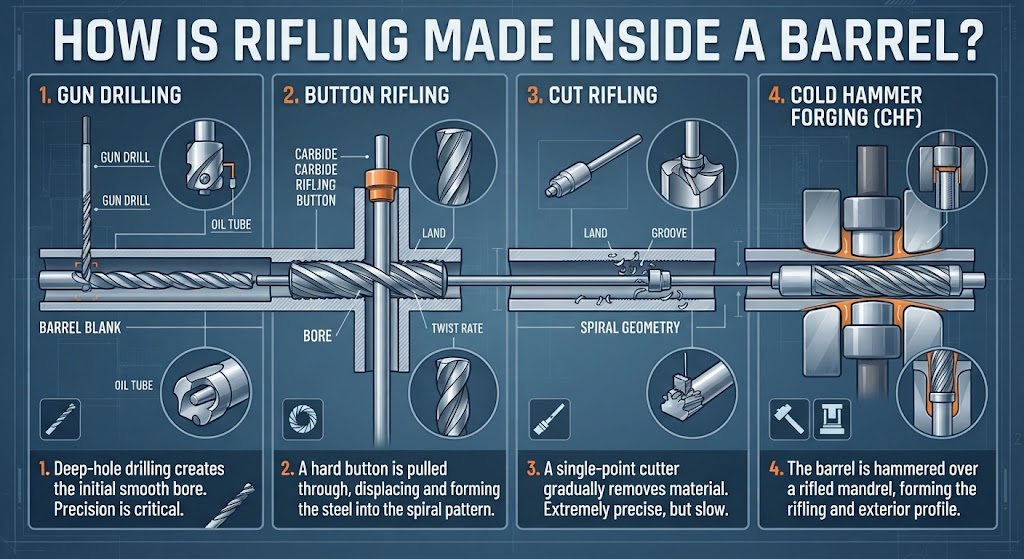
Before rifling exists, manufacturers first need a precise bore running through the barrel blank.
Specialized deep-hole drilling processes are commonly used in barrel manufacturing.
One technique associated with this work is gun drilling.
After drilling, additional finishing processes may be used to improve the bore's dimensions and surface condition before rifling.
The manufacturer is trying to create an extremely consistent starting surface.
Any variation introduced early in manufacturing can potentially influence later operations.
What Creates the Twist?
Here's the interesting part.
A barrel's twist isn't created the same way with every rifling process.
Depending on the manufacturing method, the spiral can be:
Formed into the steel
Cut into the steel
or
Hammer-forged around a rifled mandrel
That's why understanding the different manufacturing methods is so useful.
1. Button Rifling
Button rifling is one of the most widely used methods of producing rifled firearm barrels.
Despite the name, the "button" isn't anything like a clothing button.
It's a very hard precision tool containing the reverse geometry needed to form the rifling.
During manufacturing, the button passes through the prepared bore.
Rather than removing the rifling grooves in the same manner as conventional cutting, the tool displaces and forms the barrel material into the desired rifling geometry.
The tool's geometry and controlled movement establish the rifling pattern and twist.
Why Is It Called Button Rifling?
The specialized forming tool is relatively short compared with the barrel, which contributed to the term rifling button.
The button contains extremely precise geometry.
As it moves through the bore, the tool forms the lands and grooves that will ultimately impart spin to the projectile.
Advantages of Button Rifling
Button rifling is popular because manufacturers can achieve excellent bore consistency while producing barrels efficiently.
Potential advantages include:
High production efficiency
Excellent dimensional consistency when properly controlled
Good surface finish
Excellent accuracy potential
It's important to emphasize the last point:
Button-rifled barrels can be extremely accurate.
A barrel doesn't need to be cold hammer forged or cut rifled to be a high-quality barrel.
A Manufacturing Challenge With Button Rifling
Because button rifling forms the steel through significant mechanical pressure, the process can introduce residual stresses into the barrel blank.
For this reason, manufacturers may use carefully controlled stress-relieving processes as part of production.
This illustrates an important theme in barrel manufacturing:
The manufacturing method is only as good as the process control behind it.
2. Single-Point Cut Rifling
Cut rifling takes a very different approach.
Instead of forming multiple grooves simultaneously through displacement, traditional single-point cut rifling removes very small amounts of material.
A specialized cutter travels through the bore while following the desired spiral path.
Material is removed gradually.
The operation is repeated until the required rifling geometry is achieved.
Why Does Cut Rifling Take Longer?
Because only a very small amount of material is removed during each cutting operation, numerous passes may be necessary.
That makes single-point cut rifling relatively slow compared with high-volume manufacturing methods.
However, the process offers extremely precise control.
That's one reason cut rifling is frequently associated with premium and precision-oriented barrel manufacturing.
Advantages of Cut Rifling
Potential advantages include:
Precise control over rifling geometry
Relatively low forming stress compared with displacement methods
Excellent accuracy potential
Flexibility for specialized rifling configurations
The tradeoff is primarily manufacturing time and cost.
3. Broach Rifling
Broach rifling is another cutting-based method.
Instead of a single cutter gradually producing one portion of the rifling, a broach uses multiple cutting elements arranged progressively.
As the tool moves through the bore, successive cutting surfaces remove material until the desired rifling profile is produced.
Think of it conceptually as multiple cutting stages incorporated into a specialized tool.
Broach vs. Single-Point Cut Rifling
Both processes remove material, but they do it differently.
| Single-Point Cut | Broach |
|---|---|
| Small cutter | Multi-tooth cutting tool |
| Many controlled passes | Progressive cutting surfaces |
| Relatively slow | Potentially faster |
| Highly controlled | Production-oriented |
| Removes material | Removes material |
Both methods have been successfully used to manufacture firearm barrels.
4. Cold Hammer Forging
Cold hammer forging—usually abbreviated CHF—is dramatically different from the previous methods.
Instead of cutting or pushing a rifling tool through the finished bore, the barrel blank is formed around a specialized mandrel.
That mandrel contains the inverse geometry of the barrel's internal features.
Large forging machinery repeatedly hammers the barrel blank while it surrounds the mandrel.
The steel flows and forms around the mandrel.
When the process is complete and the mandrel is removed, the internal geometry has been transferred into the barrel.
Why Is It Called Cold Hammer Forging?
"Cold" doesn't mean the steel is literally refrigerated.
It means the forming process occurs below the temperatures normally associated with hot forging.
Enormous mechanical forces reshape the metal.
The process can simultaneously establish important internal barrel geometry depending on the manufacturing system being used.
Why Do Manufacturers Use CHF?
Cold hammer forging can be extremely efficient once a manufacturer has invested in the necessary machinery and tooling.
The equipment itself is substantial and expensive.
For manufacturers producing large quantities of barrels, however, CHF can offer significant production advantages.
CHF barrels are also strongly associated with military and hard-use applications.
Button vs. Cut vs. CHF Rifling
Here's an easy comparison for customers:
| Method | How Rifling Is Created | Relative Production Speed | Common Association |
|---|---|---|---|
| Button | Steel is displaced/form-pressed | Fast | Commercial & precision barrels |
| Single-Point Cut | Material gradually removed | Slow | Precision/custom barrels |
| Broach | Multiple cutters remove material | Medium/Fast | Production barrels |
| Cold Hammer Forged | Barrel formed around mandrel | Fast at production scale | Military/hard-use barrels |
This table also makes an excellent graphic for the blog.
Does CHF Automatically Mean Better?
No.
This is one of the biggest misconceptions surrounding barrel manufacturing.
Seeing:
COLD HAMMER FORGED
on a product description doesn't automatically mean that barrel will be more accurate than every button-rifled barrel.
Likewise, a button-rifled barrel isn't automatically lower quality because the manufacturing process can be less expensive at scale.
The final result depends on much more.
What Actually Determines Barrel Quality?
The rifling method is only one piece of the equation.
Barrel quality can also depend on:
Steel quality
Bore consistency
Rifling consistency
Chamber machining
Crown quality
Heat treatment
Stress relief
Surface treatment
Concentricity
Manufacturing tolerances
Quality control
A well-manufactured button-rifled barrel can outperform a poorly manufactured CHF barrel.
Manufacturing method alone isn't a quality grade.
Traditional vs. Polygonal Rifling
There's another distinction customers sometimes encounter.
Not all rifling has the same internal profile.
Traditional Lands-and-Grooves
Traditional rifling contains clearly defined raised areas called lands and recessed areas called grooves.
This design is extremely common.
Polygonal Rifling
Polygonal rifling uses smoother, more rounded internal geometry rather than the sharply defined traditional land-and-groove profile.
Polygonal designs are commonly associated with certain handgun manufacturers but can also appear elsewhere in the firearm industry.
This is different from discussing button versus CHF.
Button, cut and CHF describe manufacturing methods.
Traditional and polygonal describe rifling geometry.
That's an important distinction.
What About 5R Rifling?
Another term customers may encounter is:
5R Rifling
The "5" refers to the number of rifling lands.
The "R" is associated with the rifling design.
5R rifling typically uses five lands with geometry intended to reduce sharp opposing land transitions compared with some conventional rifling arrangements.
Again, this describes rifling geometry, not necessarily the manufacturing process.
A manufacturer can use different techniques to create different rifling profiles.
How Is a Specific Twist Rate Created?
Whether a manufacturer wants:
1:7
1:8
or another twist rate, the manufacturing tooling and process must establish that rotational geometry consistently along the bore.
With cut rifling, the cutting tool follows the specified spiral.
With button rifling, the tooling/process establishes the spiral as the button forms the bore.
With cold hammer forging, the internal geometry is transferred from the specialized mandrel as the barrel is forged.
Different machinery.
Same basic objective:
Create precisely controlled spiral geometry inside the bore.
Why Precision Matters
Imagine a rifling spiral that changes unpredictably as it travels through the barrel.
That's obviously not desirable.
Manufacturers therefore have to control much more than simply whether grooves exist.
Consistency in dimensions, surface condition, alignment and rifling geometry all matter.
Modern barrel manufacturing combines specialized tooling, precision machinery, measurement equipment and quality-control procedures to achieve that consistency.
Machining Doesn't Stop With Rifling
Once the bore and rifling exist, the barrel still isn't necessarily finished.
Depending on the manufacturer's production process, additional operations may involve machining the chamber, profiling the exterior, creating required features, threading, marking, applying treatments or finishes, and conducting inspections.
That's why a finished AR barrel represents far more manufacturing work than a simple steel tube with grooves inside it.
Frequently Asked Questions
How are grooves made inside a firearm barrel?
Manufacturers use specialized processes including button rifling, cut rifling, broach rifling and cold hammer forging.
Does a normal drill bit create the rifling?
No. Drilling creates the initial bore. Specialized tooling and machinery subsequently create or form the rifling.
What is button rifling?
Button rifling uses a hard precision tool to form the rifling geometry by displacing material within the bore.
What is cut rifling?
Cut rifling removes small amounts of material using specialized cutting equipment to gradually create the rifling.
What does CHF mean?
CHF stands for Cold Hammer Forged, a manufacturing process in which a barrel blank is mechanically formed around a specialized mandrel.
Is cold hammer forging more accurate?
Not automatically. CHF describes the manufacturing method. Accuracy depends on the complete barrel design and manufacturing quality.
Is button rifling cheap or low quality?
No. High-quality and highly accurate barrels can be manufactured using button rifling.
Is 5R the same as button rifling?
No. 5R describes rifling geometry, while button rifling describes a manufacturing method.
Conclusion
The spiral inside a firearm barrel may look simple, but manufacturing it requires extremely specialized equipment and careful process control.
The major methods include:
BUTTON RIFLING — forms the rifling through material displacement.
CUT RIFLING — gradually removes material to create the grooves.
BROACH RIFLING — uses progressive cutting surfaces.
COLD HAMMER FORGING — forms the barrel around a rifled mandrel.
And then there are rifling designs such as traditional lands-and-grooves, polygonal and 5R.
The biggest takeaway is:
Don't confuse the rifling design with the method used to manufacture it.
And don't assume one manufacturing method automatically guarantees a superior barrel.
Good barrels come from good materials, precise machinery, controlled processes and consistent quality control.

