
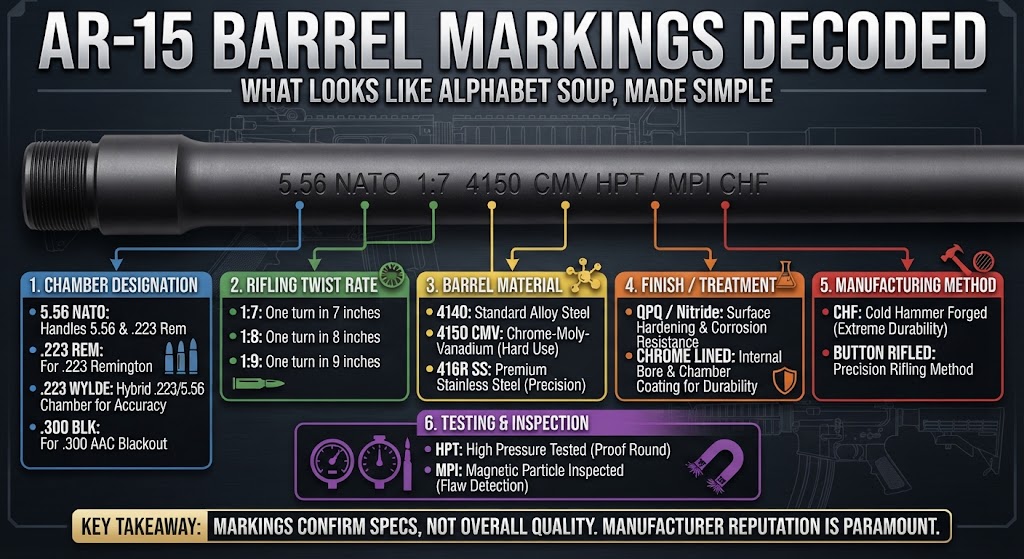
AR-15 Barrel Markings Explained
Take a close look at an AR-15 barrel and you may find a short string of letters and numbers that looks something like:
5.56 NATO 1:7 4150 CMV
or:
.223 WYLDE 1:8 SS
Other barrels might include abbreviations such as:
CHF • QPQ • CL • MPI • HPT
To someone familiar with barrel specifications, those markings can communicate quite a bit.
To a new AR owner, they can look like alphabet soup.
Understanding these markings can help you determine a barrel's chambering, twist rate, material, finish, manufacturing process and testing.
Let's break down some of the most common markings.
1. Caliber and Chamber Markings
One of the most important markings identifies the cartridge or chamber for which the barrel was manufactured.
Common AR-pattern markings include:
5.56 NATO
A barrel marked 5.56 NATO is chambered for the 5.56×45mm NATO cartridge.
This is one of the most common chamberings found on AR-15-pattern firearms.
.223 Rem
This indicates a barrel chambered for .223 Remington.
Although .223 Remington and 5.56 NATO cartridges have very similar external dimensions, their chamber specifications and pressure standards aren't identical.
For that reason, you shouldn't assume every barrel marked ".223" has the same ammunition compatibility as one marked "5.56 NATO."
Always follow the barrel or firearm manufacturer's ammunition recommendations.
.223 Wylde
Despite its name, .223 Wylde isn't a cartridge.
It's a chamber design intended to accommodate both .223 Remington and 5.56 NATO ammunition while incorporating chamber geometry intended to provide good accuracy potential.
This is why .223 Wylde has become popular in commercial AR barrels.
.300 BLK
This identifies a barrel chambered for .300 AAC Blackout, commonly abbreviated .300 BLK.
Because multiple AR cartridges can use components that look similar externally, checking the actual barrel marking is particularly important.
2. Twist-Rate Markings
You may see:
1:7
1:8
or
1:9
This describes the barrel's rifling twist.
For example:
1:7 = one complete rifling rotation every seven inches.
We've covered twist rate separately, so the important thing here is simply knowing how to recognize it when reading a barrel.
A marking such as:
5.56 NATO 1:7
therefore tells you two separate things:
Chamber: 5.56 NATO
Twist: 1 turn in 7 inches
3. What Does 4150 Mean?
If your barrel says 4150, it's referring to the barrel's steel family.
4150 is a chromium-molybdenum alloy steel commonly associated with AR barrels.
You'll also frequently encounter:
4150 CMV
CMV generally refers to Chrome-Moly-Vanadium steel.
This type of steel is widely used for barrels intended to tolerate demanding operating conditions.
4. What Does 4140 Mean?
4140 chrome-moly steel is another alloy steel used in firearm barrels.
The names 4140 and 4150 refer to steel compositions.
One important difference is carbon content.
Generally speaking, 4150 contains more carbon than 4140, which can contribute to differences in strength and heat-treatment characteristics.
But don't make the mistake of judging an entire barrel from the steel designation alone.
Material is only one part of barrel quality.
Machining, heat treatment, rifling, chamber dimensions, finishing and quality control matter too.
5. What Does CMV Mean?
CMV commonly stands for:
Chrome-Moly-Vanadium
This describes a steel alloy containing chromium, molybdenum and vanadium.
You'll frequently see barrels marketed as:
4150 CMV
or:
Chrome Moly Vanadium Steel
Don't confuse chrome-moly with chrome-lined.
They're two different things.
Chrome-moly describes the barrel material.
Chrome-lined describes a treatment applied to the barrel's interior surfaces.
That distinction causes a lot of confusion.
6. What Does SS Mean?
SS normally indicates stainless steel.
Stainless barrels are especially common in AR configurations emphasizing accuracy.
Common stainless barrel steels include varieties such as 416R stainless steel.
However, seeing "SS" doesn't tell you everything about the barrel.
You still need to know the actual steel grade, chamber, rifling, manufacturer and other specifications.
7. What Does 416R Mean?
416R is a stainless steel formulated specifically for applications including firearm barrels.
It's widely encountered in precision-oriented barrels.
Stainless barrels are often selected where accuracy and machinability are priorities.
That doesn't automatically make stainless "better" than CMV.
They represent different material choices for different design priorities.
8. What Does QPQ Mean?
You may encounter barrels advertised as:
QPQ Nitride
QPQ stands for:
Quench–Polish–Quench
It's associated with a ferritic nitrocarburizing surface-treatment process.
Rather than adding a thick conventional coating to the surface, the treatment modifies the characteristics of the steel's surface.
Depending on the specific process, manufacturers use nitrocarburizing treatments to improve properties such as wear resistance and corrosion resistance.
You'll also see related terminology including:
Nitride
Black Nitride
Salt Bath Nitride
and sometimes trade-related terminology such as Melonite.
These terms aren't necessarily identical processes in every application, so manufacturer specifications matter.
9. What Does Chrome Lined Mean?
A chrome-lined barrel has chromium plating applied to internal surfaces such as the bore and chamber.
Chrome lining became closely associated with military-style barrels because of its resistance to corrosion and wear under demanding conditions.
This is different from CMV steel.
A barrel can be:
4150 CMV + chrome lined
because one describes the underlying material while the other describes an internal surface treatment.
10. Nitride vs. Chrome Lined
These two are frequently compared.
| Feature | Nitride/QPQ | Chrome Lined |
|---|---|---|
| Type | Surface treatment | Applied lining |
| Corrosion resistance | Very good when properly processed | Excellent |
| Wear resistance | Very good | Excellent |
| Common on AR barrels | Yes | Yes |
| Military association | Less traditional | Strong |
| Changes underlying surface | Yes | Adds lining |
Neither label by itself guarantees that one barrel will outperform another.
Manufacturing quality still matters.
11. What Does CHF Mean?
CHF stands for:
Cold Hammer Forged
This refers to the method used to manufacture the barrel.
During cold hammer forging, machinery forms the barrel around a mandrel using repeated hammering forces.
CHF barrels have developed a strong reputation for durability and are commonly found in hard-use firearm applications.
However:
CHF does not automatically mean a barrel is more accurate.
It tells you how the barrel was manufactured—not its guaranteed performance.
12. Button Rifled
Not every barrel is cold hammer forged.
Many high-quality barrels are button rifled.
In this process, a hard forming tool is passed through the bore to form the rifling.
Button rifling is extremely common and can produce excellent barrels.
So:
CHF ? automatically good
and
Button rifled ? automatically inferior.
Execution matters.
13. What Does HPT Mean?
HPT stands for:
High Pressure Tested
In firearms manufacturing, this generally means the relevant component has undergone a high-pressure proof-testing procedure.
When you see HPT in specifications, it's referring to testing, not the material from which the component was manufactured.
14. What Does MPI Mean?
MPI stands for:
Magnetic Particle Inspection
This is a nondestructive inspection method used to detect certain surface and near-surface discontinuities in ferromagnetic materials.
It's frequently mentioned in AR specifications for barrels and bolts.
Again, MPI describes an inspection process.
It isn't a type of steel or coating.
15. HPT vs. MPI
These terms are often printed together:
HPT / MPI
But they mean different things.
HPT = proof testing
MPI = inspection
A manufacturer may use both as part of its quality-control process.
If testing procedures are important to you, check whether the manufacturer states that every component is individually tested or whether testing is performed on a sample or batch basis.
That's a detail an abbreviation alone may not reveal.
16. What Does CL Mean?
Depending on the manufacturer, CL commonly indicates:
Chrome Lined
But abbreviations aren't universally standardized across every barrel manufacturer.
Whenever you're uncertain, check that specific manufacturer's specifications rather than relying exclusively on an abbreviation chart.
17. What Does NATO Mean?
When you see:
5.56 NATO
“NATO” refers to the cartridge/chamber designation associated with the North Atlantic Treaty Organization standard.
It isn't a brand or barrel material.
This sounds obvious once explained, but beginners often encounter several specifications printed together and aren't sure which part describes what.
Reading a Barrel Marking From Start to Finish
Suppose a barrel is marked:
5.56 NATO 1:7 4150 CMV
You can break it down like this:
5.56 NATO ? Chamber designation
1:7 ? Rifling twist rate
4150 ? Steel family/designation
CMV ? Chrome-Moly-Vanadium
Suddenly that string of numbers and letters contains useful information.
Another Example
Suppose the specifications say:
.223 WYLDE • 1:8 • 416R SS
That generally tells you:
.223 Wylde ? Chamber
1:8 ? Twist rate
416R ? Stainless steel grade
SS ? Stainless steel
That's why learning the terminology makes shopping for AR barrels considerably easier.
What Barrel Markings DON'T Tell You
This may be the most important section of the article.
A long list of impressive abbreviations doesn't automatically tell you how good a barrel is.
A marking may tell you the:
Chamber
Twist
Material
Treatment
or
Testing process
But it may not tell you about:
Manufacturing tolerances, chamber consistency, bore quality, crown quality, quality control, actual accuracy, or long-term durability.
Specifications matter—but so does the manufacturer behind them.
Common Barrel-Markings Cheat Sheet
| Marking | General Meaning |
|---|---|
| 5.56 NATO | Chamber designation |
| .223 REM | .223 Remington chamber |
| .223 WYLDE | Hybrid-style .223/5.56 chamber design |
| .300 BLK | .300 AAC Blackout |
| 1:7 | One rifling turn every 7 inches |
| 1:8 | One rifling turn every 8 inches |
| 1:9 | One rifling turn every 9 inches |
| 4140 | Chrome-moly alloy steel |
| 4150 | Higher-carbon chrome-moly steel family |
| CMV | Chrome-Moly-Vanadium |
| 416R | Barrel-grade stainless steel |
| SS | Stainless steel |
| QPQ | Quench-Polish-Quench treatment |
| CHF | Cold Hammer Forged |
| CL | Commonly Chrome Lined |
| HPT | High Pressure Tested |
| MPI | Magnetic Particle Inspected |
Save this chart—it makes a useful quick reference when comparing barrels.
Frequently Asked Questions
What do the numbers stamped on an AR-15 barrel mean?
They commonly identify specifications such as caliber/chamber, rifling twist and barrel material. The exact format varies by manufacturer.
What does 4150 CMV mean?
It identifies a chrome-moly-vanadium steel commonly used for firearm barrels.
Does CMV mean chrome lined?
No. CMV describes the underlying alloy. Chrome lining is an additional internal surface treatment.
What does QPQ mean on an AR barrel?
QPQ stands for Quench-Polish-Quench and is associated with a nitrocarburizing surface-treatment process.
What does MPI mean?
MPI stands for Magnetic Particle Inspection, a nondestructive inspection method used to identify certain discontinuities in suitable metal components.
Does CHF mean the barrel is better?
Not automatically. Cold hammer forging is a manufacturing method. Material quality, machining, design, finishing and quality control also influence barrel performance.
Why doesn't my barrel have all these markings?
Manufacturers use different marking practices. Some put only caliber and twist on the barrel while providing the remaining specifications on packaging or the product page.
Conclusion
The markings on an AR-15 barrel aren't random.
Once you understand the abbreviations, they can quickly tell you a surprising amount about the component.
Remember to separate them into categories:
CHAMBER — 5.56 NATO, .223 Rem, .223 Wylde, .300 BLK
TWIST — 1:7, 1:8, 1:9
MATERIAL — 4140, 4150 CMV, 416R
FINISH/TREATMENT — QPQ, Nitride, Chrome Lined
MANUFACTURING — CHF, Button Rifled
TESTING — HPT, MPI
Once you know which category each abbreviation belongs to, reading a barrel specification becomes much easier.
And most importantly:
Don't judge barrel quality from one abbreviation alone.
A quality barrel is the result of appropriate material, proper manufacturing, precise machining, suitable finishing and consistent quality control working together.

