
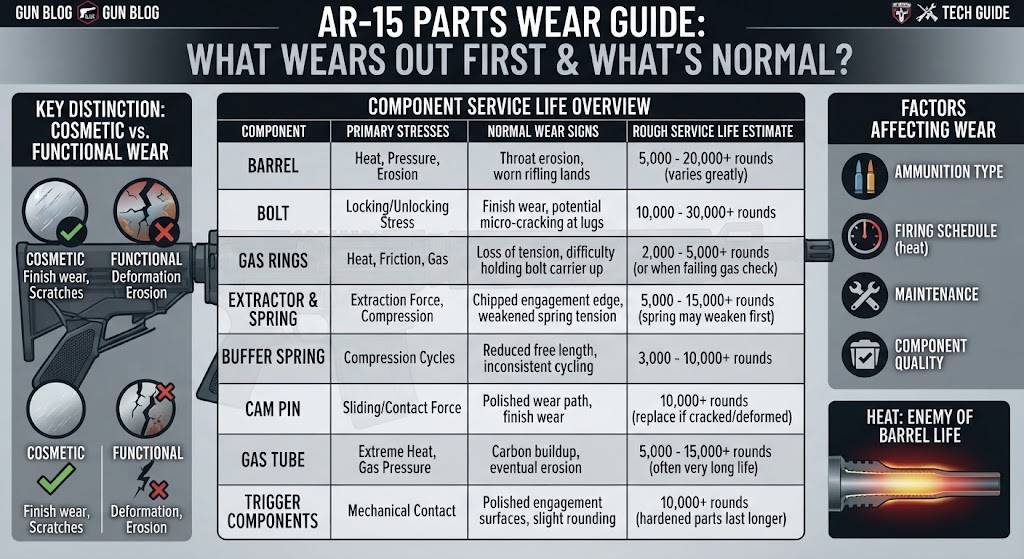
AR-15 Parts Wear Guide: What Wears Out First & What’s Normal?
AR-15 components don't last forever.
Every time a firearm is used, components are exposed to some combination of heat, friction, impact, pressure and repeated mechanical cycling.
But not every scratch, shiny spot or worn finish means there's a problem.
Some wear is completely normal.
Other changes can indicate that a component deserves closer inspection.
This raises an important question:
Which AR-15 parts typically wear first, and how long should they last?
There's no universal round-count answer. Ammunition, firing schedule, barrel characteristics, maintenance, component quality and operating conditions can dramatically affect service life.
Instead of relying on a single number, understanding where and why wear occurs is much more useful.
Cosmetic Wear vs. Functional Wear
This is the first distinction every AR owner should understand.
Cosmetic Wear
Cosmetic wear affects appearance without necessarily affecting function.
Examples can include finish wear on contact surfaces, scratches from normal handling, polished-looking areas where components repeatedly contact one another, and discoloration caused by use.
A component doesn't automatically need replacement simply because it no longer looks new.
Functional Wear
Functional wear is different.
This occurs when material loss, cracking, deformation, erosion or another change begins affecting the component's ability to perform its intended function safely and reliably.
That's when appearance becomes more than cosmetic.
Which AR-15 Parts Experience Normal Wear?
Some components naturally experience more wear than others.
| Component | Common Sources of Wear |
|---|---|
| Barrel | Heat, pressure and erosion |
| Bolt | Repeated locking/unlocking stresses |
| Gas rings | Friction and cycling |
| Extractor | Repeated case extraction |
| Extractor spring | Repeated compression |
| Ejector & spring | Repeated cycling |
| Cam pin | Sliding/contact forces |
| Firing pin | Repeated impact |
| Buffer spring | Repeated compression cycles |
| Gas tube | Heat and gas exposure |
| Trigger components | Repeated mechanical contact |
These components shouldn't all be expected to wear at the same rate.
The Barrel
The barrel is one of the components most commonly associated with firearm service life.
Each shot exposes the chamber, throat and bore to heat and high-pressure combustion gases.
The area immediately forward of the chamber—the throat—is particularly susceptible to erosion.
Over enough use, that erosion can gradually affect performance.
But asking:
“How many rounds does an AR-15 barrel last?”
doesn't have one universal answer.
How Many Rounds Does an AR-15 Barrel Last?
You'll see figures ranging from several thousand rounds to tens of thousands online.
The reason for such a wide range is that “barrel life” can mean different things.
A precision shooter might consider a barrel worn when accuracy deteriorates beyond their requirements.
Another owner may continue using that same barrel considerably longer if it remains safe and provides acceptable performance for their purposes.
Firing schedule matters enormously as well.
Repeated rapid firing creates substantially more heat than slower recreational use.
In many cases:
Heat is one of the biggest enemies of barrel life.
The Bolt
The AR bolt is another component worth paying attention to because it experiences repeated stress during operation.
Every firing cycle involves locking, firing, unlocking and cycling.
That means certain bolt areas undergo thousands of repeated loading cycles over the firearm's life.
Normal finish wear can occur.
What is more concerning is cracking, deformation or damage.
If something looks questionable, particularly around heavily stressed portions of the bolt, the appropriate response isn't simply to continue firing until the firearm stops functioning.
Have it inspected.
Gas Rings
Gas rings are small components, but they perform an important sealing function within the bolt carrier system.
Because they're constantly exposed to heat, gas and movement, they're considered wear items.
There's no reason to replace perfectly functional gas rings simply because someone online says they've reached an arbitrary round count.
Their condition and performance matter more than the odometer.
Extractor & Extractor Spring
The extractor repeatedly engages cartridge cases during operation.
That makes the extractor, its spring and related components another area where wear can eventually appear.
A damaged or heavily worn extractor may contribute to extraction problems.
But again, one malfunction doesn't automatically prove that the extractor is worn out.
Ammunition, chamber condition, fouling and other factors can produce similar symptoms.
Good troubleshooting means evaluating the complete system instead of immediately blaming one component.
Cam Pin Wear
It's common to see visible finish wear on an AR cam pin.
The cam pin moves within the carrier and interacts with the upper receiver during normal operation.
That contact can produce polished or worn-looking areas.
Visible finish wear alone isn't automatically evidence of component failure.
Cracks, substantial deformation or unusual damage are different and deserve professional inspection.
Buffer Spring
The action spring—often called the buffer spring—is repeatedly compressed and released as the firearm cycles.
Over substantial use, springs can eventually lose performance.
However, replacing a spring solely because you've reached a particular internet round-count recommendation isn't always necessary.
Maintenance schedules can be useful, but manufacturer specifications and actual component condition should take priority over arbitrary numbers.
Gas Tube
The gas tube operates in an extremely hot environment.
Hot propellant gases travel through it every time the firearm cycles.
Despite that environment, gas tubes can have surprisingly long service lives under ordinary use.
Extremely high firing schedules create a very different situation, however.
This is another example of why round count alone doesn't tell the complete story.
5,000 rounds fired slowly over several years isn't necessarily equivalent to 5,000 rounds fired through extremely aggressive firing schedules.
Same round count.
Very different thermal stress.
Does the Upper Receiver Wear Out?
Upper receivers certainly develop wear.
Common examples include contact wear inside the receiver and finish wear where moving components interact.
That doesn't automatically mean the receiver is worn out.
Quality aluminum receivers can have very long service lives.
Structural cracking, unusual deformation, severe damage or dimensional problems are much more meaningful than superficial finish wear.
Does the Lower Receiver Wear Out?
The lower receiver itself generally isn't treated as a routine consumable component.
Many of the components installed inside it experience more mechanical cycling than the receiver body.
Springs, pins, trigger components and controls can all experience wear.
Again, the distinction between a worn internal component and a damaged receiver is important.
Why Round Count Isn't Everything
Imagine two otherwise identical rifles.
Rifle A:
5,000 rounds fired gradually over several years.
Rifle B:
5,000 rounds fired through frequent high-volume sessions that repeatedly bring the firearm to very high temperatures.
Their round counts are identical.
Their components haven't necessarily experienced identical conditions.
Other variables include ammunition pressure, suppressed versus unsuppressed use, barrel material and treatment, lubrication, environmental conditions, component quality and maintenance.
That's why round count should be considered one maintenance data point—not a universal expiration date.
What Wear Is Usually Normal?
Depending on the component, normal use may produce:
Finish polishing on contact surfaces, minor scratches, carbon buildup, slight discoloration and visible contact patterns.
A firearm doesn't have to look brand new to be serviceable.
In fact, some contact patterns simply demonstrate where components naturally interact.
The key is learning to distinguish normal wear patterns from actual damage.
What Should Get Your Attention?
Certain observations deserve more attention than ordinary finish wear.
These include visible cracks, chipped or broken components, unusual deformation, severe erosion, loose components that should remain secure, sudden changes in reliability, or a significant unexplained change in performance.
If you're uncertain whether something is normal wear or structural damage, having the firearm inspected by a qualified gunsmith or the component manufacturer is the safer choice.
Should You Replace AR Parts at a Specific Round Count?
Not necessarily.
Preventive maintenance schedules can make sense—especially for firearms subjected to high-volume or professional use—but there isn't one universal replacement schedule for every AR-15.
A better approach combines:
Round-count awareness + routine inspection + manufacturer recommendations + actual performance.
That gives you much more useful information than treating every component like it has a predetermined expiration date.
Frequently Asked Questions
What AR-15 part normally wears out first?
There isn't one guaranteed first component. Springs, gas rings, extractors and other moving components are common wear items, while barrel wear becomes increasingly relevant with higher round counts and heat exposure.
How many rounds does an AR-15 barrel last?
There is no universal number. Barrel material, ammunition, firing schedule, heat and the shooter's accuracy requirements all affect what constitutes the end of useful barrel life.
Is wear inside an AR-15 upper normal?
Some finish and contact wear can be normal. Cracking, deformation or unusual damage should be evaluated separately.
Should I replace my bolt after a certain number of rounds?
Round count can be useful for tracking maintenance, but the manufacturer's recommendations, inspection and component condition are more meaningful than a universal replacement number.
Does rapid firing wear an AR faster?
High-volume firing can dramatically increase heat, particularly in the barrel. Greater thermal stress can accelerate certain forms of wear.
Are scratches on AR parts a problem?
Not necessarily. Cosmetic finish wear and structural damage are very different things.
Conclusion
An AR-15 doesn't suddenly become worn out when the round counter reaches a particular number.
Different components experience different types of stress.
Some parts are natural wear items. Others can remain serviceable through extremely high round counts.
The most important lesson is simple:
Don't judge an AR component solely by how it looks or how many rounds have passed through the firearm.
Understand what normal wear looks like, keep track of your firearm's use, follow manufacturer recommendations and pay attention when performance changes.
Round count tells part of the story. Condition tells the rest.

