
AR-15 Feed Ramps Explained: M4 vs. Rifle Feed Ramps
When shopping for an AR-15 upper receiver or barrel, you've probably encountered this specification:
M4 Feed Ramps
It's frequently listed alongside specifications such as 7075-T6 aluminum, M4 barrel extension and MIL-STD 1913 Picatinny rail.
But what exactly is a feed ramp?
And what's the difference between M4 feed ramps and traditional rifle feed ramps?
The answer starts with understanding what happens as a cartridge moves from the magazine toward the chamber.
What Is an AR-15 Feed Ramp?
Feed ramps are angled surfaces that help guide a cartridge toward the chamber as the firearm cycles.
On an AR-pattern system, the primary feed-ramp geometry is associated with the barrel extension.
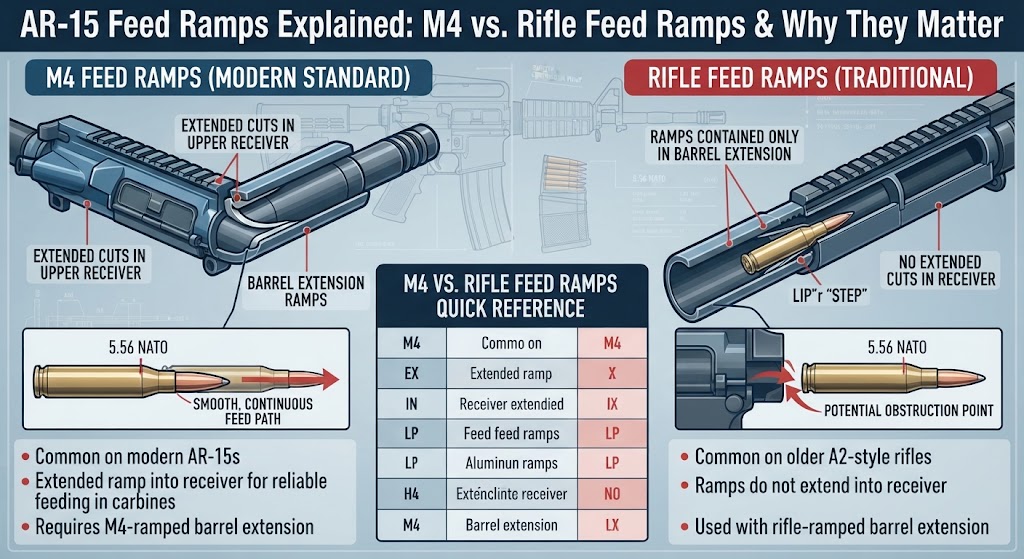
With an M4-style configuration, the ramp cuts extend farther downward into corresponding cuts in the upper receiver.
This creates the distinctive extended feed-ramp arrangement commonly found on modern AR-15 components.
What Are Rifle Feed Ramps?
Earlier AR-15/M16 configurations traditionally used what are commonly called rifle feed ramps.
In this arrangement, the ramps are contained primarily within the barrel extension rather than extending downward into the upper receiver.
For the original rifle configuration, this design served its intended purpose.
The later M4 configuration introduced extended feed ramps.
What Are M4 Feed Ramps?
M4 feed ramps extend the feed-ramp geometry farther downward.
Instead of stopping entirely at the barrel extension, corresponding cuts in an M4-style upper receiver continue the feeding surface below the extension.
The result is a longer transition area for the cartridge as it moves toward the chamber.
This is why you'll often see both:
M4 feed ramps
and
Machined for M4 barrel extensions
listed in modern stripped-upper specifications.
M4 vs. Rifle Feed Ramps
| Feature | Rifle Feed Ramps | M4 Feed Ramps |
|---|---|---|
| Barrel extension ramps | Yes | Yes |
| Extended receiver cuts | No | Yes |
| Common on older rifle configurations | Yes | Less typical |
| Common on modern AR-15 uppers | Less common | Yes |
| Ramp extends into receiver | No | Yes |
For most modern AR-15 buyers, M4 feed ramps are the configuration they're most likely to encounter.
Why Were M4 Feed Ramps Developed?
The M4 carbine operates differently from the original full-length rifle configuration.
The shorter gas system and carbine's operating characteristics created different feeding demands.
Extended feed ramps were incorporated to provide additional feeding surface as cartridges transition from the magazine toward the chamber.
The design subsequently became extremely common throughout the commercial AR-15 market.
Today, M4 feed ramps aren't limited to military-style M4 carbines. They're widely encountered across civilian AR-15 upper receivers and barrels.
Where Are M4 Feed Ramps Located?
This is where people sometimes get confused.
An M4 feed-ramp setup involves two components working together:
The barrel extension contains the primary ramps.
The upper receiver contains corresponding extended cuts.
When properly matched, these surfaces form a smooth transition.
If you're looking into the rear of an assembled upper with the bolt carrier group removed, the two ramps appear at approximately the lower portion of the barrel-extension opening.
Why Does Feed-Ramp Compatibility Matter?
The important issue isn't simply whether a component has ramps.
It's whether the barrel extension and upper receiver geometry are compatible with each other.
Ideally, the transition between the receiver and barrel-extension ramps should not create an abrupt obstruction in the cartridge's path.
That's one reason buyers should pay attention to both the barrel and upper receiver specifications instead of assuming every AR component is identical.
Can You Use an M4 Barrel Extension With an M4 Upper?
Yes—this is the normal modern combination.
An upper receiver machined with M4 feed-ramp cuts is intended to work with the corresponding M4-style barrel extension.
This provides the continuous extended-ramp geometry most people recognize today.
What About Mixing Rifle and M4 Feed Ramps?
This is where the topic becomes more important.
Not every combination produces the same geometry.
M4 Upper + M4 Barrel Extension
Preferred configuration.
The extended cuts in the upper align with the M4 barrel-extension ramps.
Rifle Upper + Rifle Barrel Extension
This is the traditional configuration and does not use receiver extensions below the barrel-extension ramps.
Rifle Upper + M4 Barrel Extension
The barrel extension contains the extended-style ramps while the receiver does not.
This doesn't create the same problematic overhang as the opposite combination, although it won't produce the full continuous receiver ramp configuration.
M4 Upper + Rifle Barrel Extension
This is the combination buyers should be particularly cautious about.
The upper receiver has extended cuts, but the rifle-style barrel extension doesn't extend downward to match them.
That can create an unfavorable transition or lip between the receiver and barrel extension.
For that reason, matching an M4-ramped upper with an M4 barrel extension is the straightforward choice.
Do Feed Ramps Affect Accuracy?
Feed ramps aren't primarily an accuracy feature.
Their job concerns feeding and reliability, not determining the mechanical accuracy of the barrel.
Accuracy depends much more heavily on factors such as the barrel, ammunition, chamber, optics, shooter and overall system.
So seeing "M4 feed ramps" shouldn't be interpreted as:
This upper is more accurate.
It's better understood as a feature related to the cartridge-feeding geometry.
Are M4 Feed Ramps Better?
For a modern AR-15 configuration designed around them, M4 feed ramps are an established and extremely common solution.
However, calling them universally "better" oversimplifies the issue.
A properly configured rifle-ramp system can function correctly.
The more important issue is component compatibility and proper manufacturing.
That's a recurring theme with AR components: specifications matter most when you understand how multiple parts interact.
What Should You Look for When Buying an Upper Receiver?
When comparing stripped AR-15 upper receivers, don't stop at appearance.
Check specifications including:
Material: such as 7075-T6 aluminum
Feed ramps: M4 or other configuration
Barrel-extension compatibility
Picatinny rail specification
Forward-assist provisions
Dust-cover provisions
Finish: raw, anodized or another coating
Manufacturing method: forged or billet
These details tell you considerably more about an upper receiver than appearance alone.
M4 Feed Ramps and Gorilla Machining Upper Receivers
This is also one of the specifications you'll see on Gorilla Machining's AR-15 M4A4 Stripped Upper Receiver featuring Anchor Harvey forgings.
The receiver is machined with M4 feed ramps for use with barrels utilizing an M4 barrel extension.
That's a perfect example of why specifications such as "M4 feed ramps" appear in product descriptions.
It's not just marketing terminology.
It describes an actual feature of the receiver and its intended component compatibility.
Frequently Asked Questions
What does M4 feed ramps mean on an AR-15 upper?
It means the upper receiver has extended feed-ramp cuts designed to correspond with an M4-style barrel extension.
Are feed ramps part of the barrel or upper receiver?
The primary ramps are located on the barrel extension. An M4 configuration also includes corresponding extended cuts in the upper receiver.
Does every AR-15 have M4 feed ramps?
No. Traditional rifle configurations exist, although M4 feed ramps have become extremely common on modern commercial AR-15 components.
Do M4 feed ramps increase accuracy?
Not directly. Feed ramps primarily concern reliable cartridge feeding rather than mechanical accuracy.
Can feed ramps cause feeding problems?
Incorrect geometry, damage, manufacturing issues or an unfavorable receiver/barrel-extension combination can potentially contribute to feeding problems. However, feeding issues can have numerous other causes.
Should I modify feed ramps myself?
Removing material from a receiver or barrel extension can permanently alter the component. If you suspect a feed-ramp problem, having the components evaluated by a qualified gunsmith or manufacturer is safer than assuming material needs to be removed.
Conclusion
M4 feed ramps are a small feature with an important job.
Traditional rifle feed ramps are primarily contained within the barrel extension, while the M4 configuration extends the feeding surfaces downward into corresponding cuts in the upper receiver.
That's why modern AR product descriptions frequently specify M4 feed ramps.
More importantly, understanding the terminology helps you recognize something that applies throughout the AR platform:
Compatibility isn't just about whether two parts physically fit together. Their specifications should be designed to work together.
And the next time you see “M4 Feed Ramps” listed underneath an AR-15 upper receiver, you'll know exactly what the manufacturer is talking about.

