
Polymer AR-15 Uppers & Lowers: How Durable Are They?
Polymer has become an established firearm material.
Modern handguns demonstrate that a properly engineered polymer component can withstand years of use. But seeing polymer successfully used in a pistol frame doesn't automatically mean every component of an AR-15 is equally suited to being manufactured from polymer.
That distinction becomes particularly important when discussing AR-15 upper and lower receivers.
Polymer AR receivers have existed for years, and some designs have accumulated surprisingly high round counts. Others have developed cracks or experienced structural problems.
So how long does a polymer AR receiver actually last?
And the question we hear most often:
How many rounds can you fire before a polymer upper cracks?
The answer requires looking beyond a single round-count number.
What Is a Polymer AR-15 Receiver?
Traditional AR-15 receivers are commonly manufactured from aluminum.
Polymer receivers substitute engineered polymer for some or most of that aluminum construction.
There are several approaches.
Some receivers are primarily polymer. Others are hybrid designs that incorporate metal reinforcement at critical locations.
That difference is extremely important.
Calling something a "polymer receiver" tells you very little about its actual engineering.
Material formulation, wall thickness, reinforcement, geometry, inserts, manufacturing quality, ammunition, operating system and firing schedule can all influence durability.
Polymer Upper vs. Polymer Lower: There's a Big Difference
We shouldn't put polymer uppers and lowers into the same category.
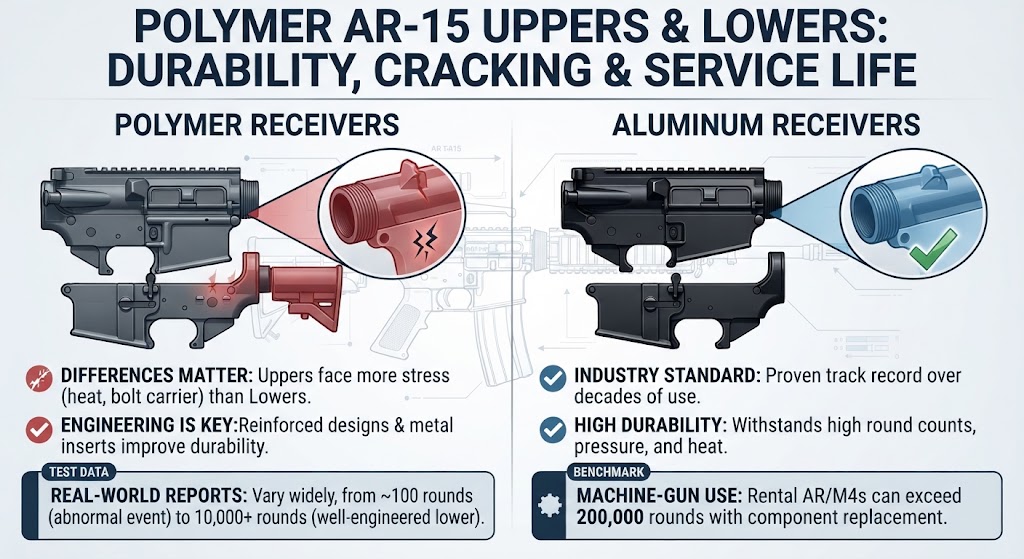
An AR-15 upper receiver operates in a considerably different environment from the lower.
The upper interfaces with the barrel assembly and bolt carrier group and is exposed to heat and repeated cycling.
The lower performs different structural and mechanical functions.
Shooting Illustrated noted this distinction years ago when discussing polymer AR receivers, explaining that the AR upper's relatively thin structure surrounding the steel barrel extension makes polymer construction more challenging, while the lower is a more practical candidate for polymer construction.
This helps explain why polymer lowers are considerably more common than polymer uppers.
How Many Rounds Until a Polymer AR Upper Cracks?
Here's where we need to separate internet claims from useful evidence.
There is no universal round count.
You cannot accurately say:
"A polymer upper cracks after X rounds."
Different designs can produce completely different results.
For example, one owner reported a polymer .22 LR upper cracking at approximately 100 rounds. However, the crack occurred following an out-of-battery detonation, not ordinary firing. It therefore would be misleading to claim that this demonstrates a normal 100-round service life.
At the opposite extreme, an ATI Omni Hybrid test reported approximately 2,100 rounds of continuous full-auto fire. The handguard reportedly caught fire at approximately 1,200 rounds, and the test eventually ended following a gas-block failure. According to the report, the reinforced polymer upper did not exhibit measurable warping at its gas-block-port area or notable cam-pin wear.
Those two examples alone demonstrate why a universal number isn't credible.
Polymer Upper Round-Count Examples
| Example | Approx. round count | Result |
|---|---|---|
| Polymer .22 LR upper owner report | ~100 | Cracked following abnormal out-of-battery event |
| ATI reinforced polymer upper test | ~2,100 | Upper reportedly survived; another component ended test |
These aren't directly comparable laboratory tests and shouldn't be interpreted as predicted service lives.
Why Can Polymer Uppers Crack?
Several factors can contribute.
Heat
Repeated firing produces considerable heat.
Polymers respond to elevated temperatures differently from aluminum, and the exact behavior depends heavily on the polymer formulation and reinforcement.
Repeated Mechanical Stress
An AR upper experiences repeated loading as the firearm cycles.
Thousands of cycles can expose weaknesses in a poorly engineered material or geometry.
Barrel Interface
The relationship between the upper receiver, barrel extension and barrel attachment area is especially important.
That's one reason some polymer upper designs incorporate metal reinforcement rather than relying exclusively on polymer.
Abnormal Events
An ammunition or mechanical malfunction can expose a receiver to forces substantially different from normal operation.
That's why the approximately 100-round cracked .22 upper mentioned earlier shouldn't be presented as evidence of normal polymer fatigue—it reportedly cracked during an abnormal event.
What About Polymer AR-15 Lowers?
Polymer lowers have a much longer and more varied track record.
And this is where things become interesting.
Some early polymer lower designs developed reputations for cracking, particularly around highly stressed areas.
Brownells identifies the region near the receiver extension/buffer-tube interface as an important stress area and notes that modern purpose-designed polymer lowers can reinforce this and other critical locations.
Other areas historically associated with polymer-lower concerns include the pivot/takedown-pin regions and bolt-catch area.
But that doesn't mean all polymer lowers fail quickly.
Far from it.
How Many Rounds Can a Polymer Lower Last?
Again, there isn't a universal number.
Anecdotal reports range enormously.
One range employee reported an E3 Arms polymer lower reaching approximately 10,000 rounds, while another owner reported approximately 7,000 rounds on a polymer lower before noticing wear to a polymer hammer—not necessarily failure of the receiver itself.
A historical AR15.com discussion also includes a claim from a person associated with the CAV/GWACS design that individual receivers had surpassed 10,000 rounds, while some Cavalry Arms examples had reportedly reached 50,000 rounds in machine-gun use. Those are user/community reports rather than controlled independent durability studies, so they should be treated accordingly.
That demonstrates an important point:
Polymer itself isn't automatically the problem. Design matters enormously.
Why Some Polymer Lowers Last Longer Than Others
A traditional AR lower was originally designed around aluminum.
Simply reproducing the same dimensions in a different material doesn't necessarily produce equivalent structural behavior.
A successful polymer design may require changes such as thicker sections, reinforced stress areas, integrated components or metal inserts.
That's an engineering principle worth remembering:
Changing the material may require changing the design.
This is why a purpose-designed polymer receiver can perform very differently from a receiver that simply attempts to duplicate an aluminum design in polymer.
Polymer vs. Aluminum AR Receivers
| Characteristic | Polymer | Aluminum |
|---|---|---|
| Weight | Potentially lighter | Lightweight |
| Material stiffness | Generally lower | Higher |
| Heat behavior | More material-dependent | Well established |
| Design dependency | Very high | Mature AR architecture |
| Metal reinforcement | Common on some designs | Generally unnecessary |
| Long-term AR track record | Highly design-dependent | Extensive |
| Upper receiver use | Relatively uncommon | Industry standard |
| Lower receiver use | Available from several manufacturers | Industry standard |
This comparison isn't saying polymer is automatically bad.
It's saying that "polymer" alone isn't enough information to judge a receiver.
What About Aluminum AR Receivers?
Aluminum remains the conventional material for AR receivers for good reasons.
The platform has decades of manufacturing knowledge behind aluminum receiver production, and quality forged aluminum receivers have demonstrated extremely high service lives.
For perspective, reports from extremely high-volume rental-machine-gun use have described some AR/M4-pattern firearms exceeding 200,000 rounds, with barrels, bolts and other components being replaced while the receivers continued in service. That's not a guarantee for every receiver, but it demonstrates how mature aluminum receiver construction is under extreme use.
That's an extraordinary difference from saying every aluminum receiver will last 200,000 rounds.
It simply gives us useful real-world context.
Does That Mean Polymer Receivers Are Bad?
No.
That's too simplistic.
Modern polymer engineering has come a long way, and well-designed polymer lowers have demonstrated substantial durability.
The more useful distinction is:
Polymer lowers have a stronger practical case than polymer uppers on the traditional AR architecture.
And within either category, construction matters enormously.
A reinforced hybrid receiver and a basic all-polymer receiver shouldn't be treated as equivalent products simply because both contain polymer.
What Should Buyers Look For?
Instead of asking only whether a receiver is "polymer," research:
The exact polymer design, whether critical areas contain metal reinforcement, the manufacturer's testing, intended caliber/application, warranty, documented long-term use, and whether the receiver was engineered around polymer rather than simply copied from an aluminum design.
The same principle applies to aluminum components.
Material is important, but engineering and manufacturing quality matter too.
Frequently Asked Questions
How many rounds does it take to crack a polymer AR upper?
There is no established number. Reported examples range dramatically depending on receiver construction, caliber, firing schedule and whether an abnormal event occurred. A claim that all polymer uppers crack after a particular number of rounds isn't supported by reliable evidence.
Can a polymer upper last 1,000 rounds?
Some designs have exceeded that. One reported ATI hybrid-polymer upper survived a roughly 2,100-round continuous full-auto test, although that was an extreme manufacturer-related demonstration rather than a normal service-life study.
Are polymer lowers more durable than polymer uppers?
They're different applications. Polymer has proven more practical in AR lowers, and purpose-designed reinforced polymer lowers have accumulated substantial round counts.
Where can polymer AR lowers crack?
Historically discussed stress areas include the receiver-extension/buffer-tube region and areas around certain pins. Modern polymer designs may reinforce these areas.
Is an aluminum receiver stronger?
Quality aluminum receivers provide a long-established combination of stiffness, strength, heat resistance and durability on the traditional AR platform. Polymer performance varies substantially by design.
Does a cheap polymer receiver automatically mean it will crack?
No. Price or material alone cannot predict service life.
Conclusion: Don't Believe a Single "Failure Round Count"
If there's one takeaway from the polymer AR debate, it's this:
There is no magic number of rounds at which a polymer AR receiver cracks.
A polymer receiver might experience an early failure because of poor design, damage or an abnormal event. A well-engineered polymer or hybrid receiver may survive thousands—or potentially tens of thousands—of rounds.
For uppers in particular, aluminum remains the much more established material on the traditional AR platform.
For lowers, the story is more nuanced. Modern purpose-designed polymer lowers have demonstrated that polymer can work extremely well when the receiver is engineered around the material rather than simply made from it.
When comparing receivers, don't just ask:
"Polymer or aluminum?"
Ask:
"How was this receiver engineered, reinforced, manufactured and tested?"
That's a much better predictor of what you're actually buying.

